Overview
Buhoma, in Uganda's Kanungu District at the northern boundary of Bwindi Impenetrable National Park, is where most gorilla trekking visitors begin and end their encounter with this part of southwest Uganda. Fewer take the time to look beyond the trailhead — to the village, the community projects, the highland farms, and the small workshops where a different kind of encounter is possible.
During a visit to the orphanage in Buhoma in January 2026, I sat with a group of children who immediately wanted to take photos and videos on my phone. What struck me was not the enthusiasm itself — children everywhere are drawn to cameras — but the realisation that many of them had never seen their own reflection. There is no mirror in the orphanage. When I showed them the group photograph on screen, the reaction was something close to wonder: pure, uncomplicated joy at simply seeing themselves. We spent an hour like that, laughing, pointing, taking turns.
That moment captures something important about community tourism in this part of Uganda. The most genuine encounters here are not staged. They arise from simply being present — at the orphanage, on the main road, at a construction site, in a terraced field. The purpose of this article is to document what those encounters look like, and what the broader fabric of community life in southwest Uganda actually involves.
Buhoma Village: Life at the Park Boundary
Buhoma sits at approximately 1,600 metres above sea level in the Kanungu District, on the edge of a forest that shelters roughly half of the world's remaining mountain gorillas. The village has grown substantially since gorilla trekking was formalised in the late 1980s — there are lodges, guesthouses, small shops, and a Uganda Wildlife Authority (UWA) ranger station. But beyond the tourism infrastructure, the village functions on the same informal economy that characterises most of rural southwest Uganda.
On Buhoma's main road, a small bench and a parasol in front of a roadside shop provide shade and cold water. We sat there one afternoon in January 2026, watching the street life — schoolchildren in uniform, motorcycles loaded with supplies, women carrying produce. It is one of those ordinary scenes that travel brochures tend to skip past, but it is exactly where you learn what a place is actually like. [VOICE FEHLT: roadside shop owner on changes to Buhoma since tourism grew]
The BodaBoda motorcycle is the essential vehicle of rural Uganda. Driving out of Buhoma on one occasion, we passed a rider transporting a stack of large water containers — jerry cans strapped and balanced across the seat, the footrests, and a rear rack. The driver wore sandals and no helmet, which remains entirely normal across rural East Africa. To a European eye it looks improvised; in context, it is simply logistics. BodaBoda operators carry passengers, construction materials, agricultural produce, and water across terrain where paved roads and formal freight services do not reach. They are infrastructure.
The HopeKitchen: A Community Project Taking Shape
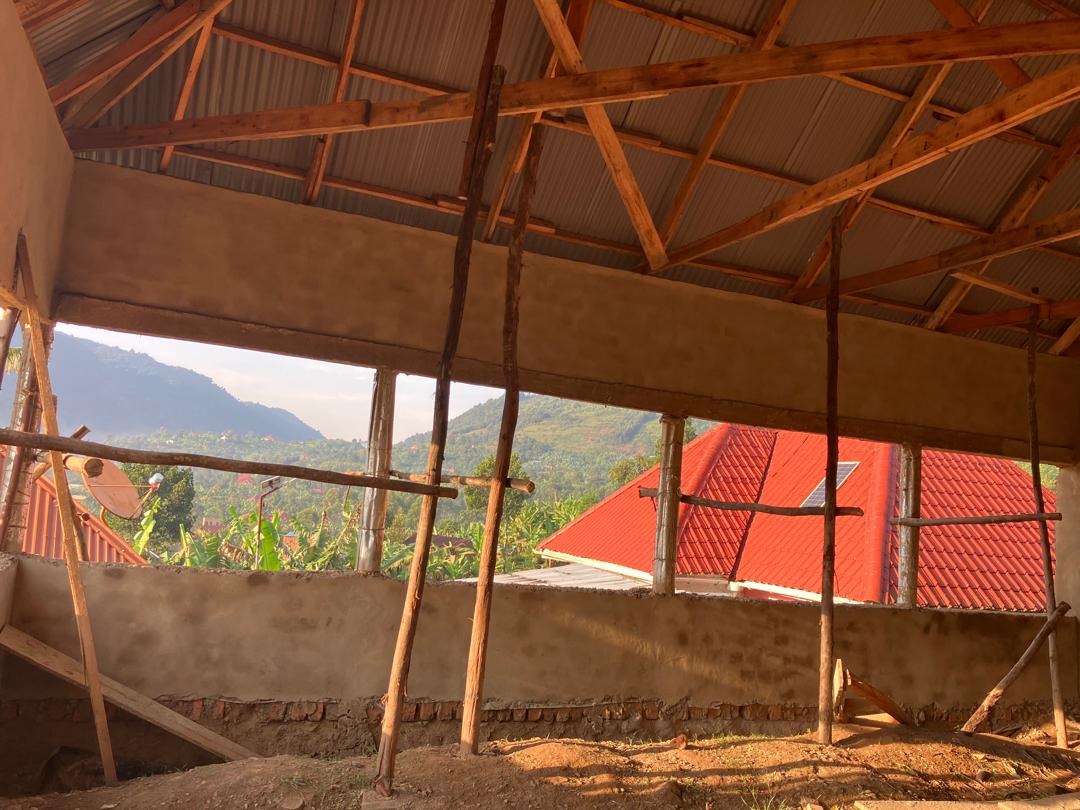
On the hillside above Buhoma, a building was taking shape in January 2026. The walls had been plastered, the red corrugated iron roof was in place, and from the open framework you could already see what the finished structure would frame: a panoramic view across the valley and the forest canopy beyond. The floor was not yet poured, but the space — even in its incomplete state — communicated its purpose clearly.
This is HopeKitchen Buhoma, a community kitchen and gathering space developed by the Hope on the Road initiative. The project follows a model that has become familiar in community development work around Bwindi: identify a gap in local infrastructure, build it in partnership with community members using local materials, and operate it in a way that generates income for the surrounding households.
The view alone is reason enough to pause. The Bwindi forest fills the horizon, layers of ridge dissolving into the haze. At that elevation in January — one of southwest Uganda's drier months — the light is clear and the valley spreads out below in deep greens and ochres. It is the kind of setting that a well-positioned community space can use to create genuine value for visitors while directing economic benefit directly to the village.
Vocational Training in Butiru: What Economic Independence Looks Like
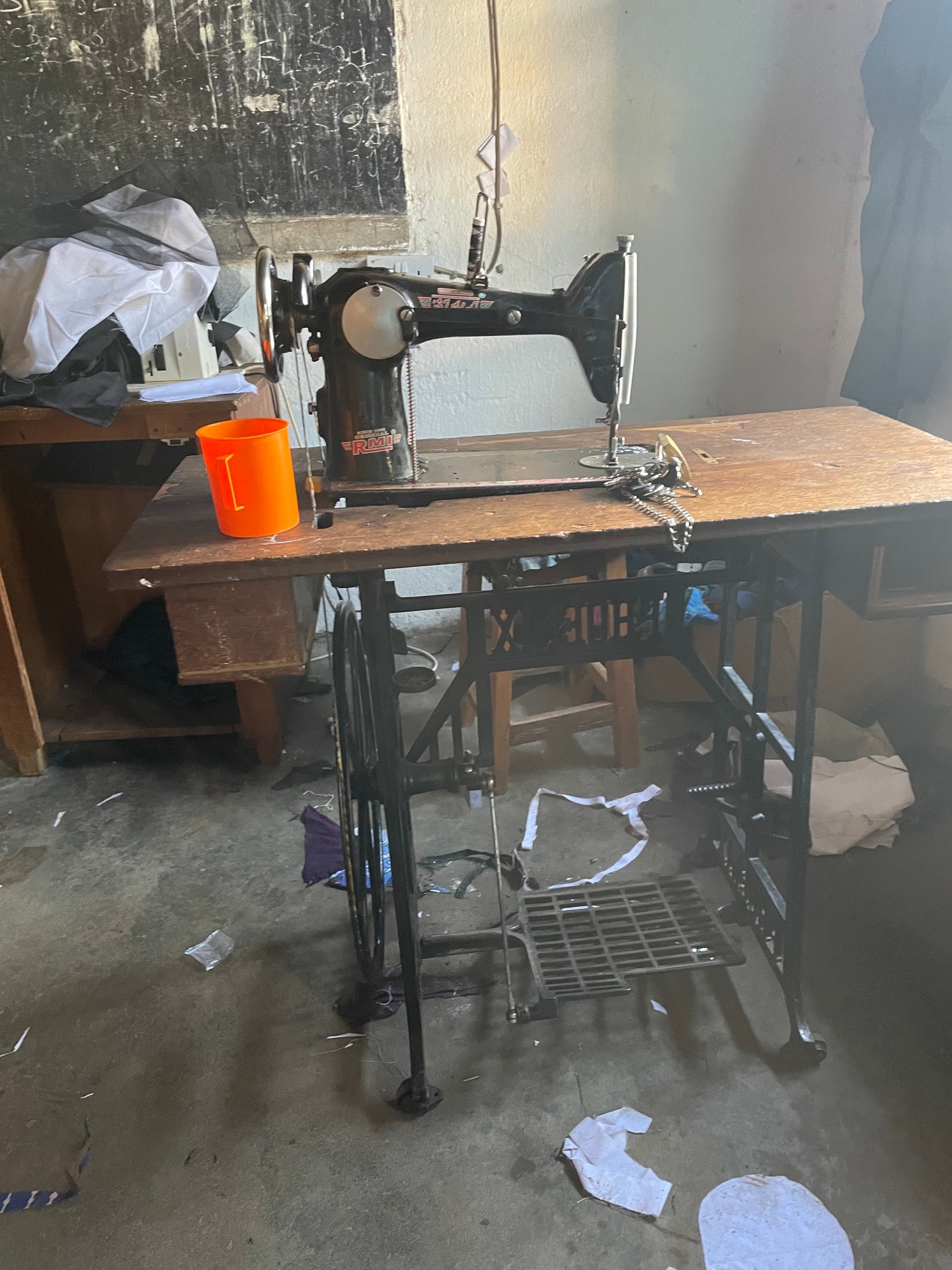
About 45 kilometres north of Bwindi, the town of Butiru in the Elgon sub-region is home to a different kind of project: a sewing and tailoring workshop housed within the local school. The workshop is supported by the Butiru Freundeskreis, a German-Ugandan partnership that funds vocational training as part of a broader educational programme at the school.
The workshop I visited in October 2024 contained rows of manual sewing machines — the kind that runs without electricity, which matters in a community where power supply is intermittent. Young women were learning tailoring from a trained instructor. The skills taught here — pattern cutting, machine operation, garment construction — are directly transferable to income-generating work. A trained seamstress in rural Uganda can operate from home, serve local markets, and build a client base without the capital investment that most formal employment requires.
This model of vocational training addresses a specific gap. Uganda's formal employment sector absorbs only a fraction of the working-age population; the remainder must generate livelihoods through self-employment, agriculture, or the informal economy. Tailoring and sewing are skills with consistent local demand — school uniforms, church clothing, household textiles — and low startup costs once training is complete.
The Butiru Freundeskreis Model
The Butiru Freundeskreis operates on the principle that long-term development partnerships require institutional continuity rather than one-off donations. The organisation has maintained a relationship with the Butiru school for over a decade, funding infrastructure improvements, teaching materials, and the vocational training programme in stages. This approach — slow, unglamorous, and sustained — is markedly different from the high-visibility aid model that generates donor attention but often creates dependencies rather than capacity.
[VOICE FEHLT: tailoring instructor at Butiru on what students do after completing the programme]
Sustainable Agriculture: Terracing on Uganda's Steep Hillsides
Travelling through the Elgon region in October 2024, the hillsides tell a particular story in stone. Across the slopes, farmers have constructed terrace walls — carefully stacked rows of rock that cut across the gradient, creating level planting surfaces and slowing the movement of water down the slope. The technique is ancient, but its application here is active and ongoing: new walls being built, old ones repaired after heavy rains.
Stone terracing is one of the most effective low-cost responses to soil erosion on steep tropical hillsides. It works by interrupting the velocity of rainfall runoff — water that would otherwise carry topsoil downslope pools behind the stone wall long enough to infiltrate into the soil. Over time, terraced slopes develop deeper, more fertile topsoil than unsuitable land. In the Elgon highlands, where rainfall is heavy and gradients can exceed 30 degrees, this technique is not optional. It is the difference between a field that remains productive across generations and one that becomes an eroded gully within a decade.
The GPS coordinates of photographs taken in the Butiru area in October 2024 place the terraced fields at approximately 0.94°N, 34.28°E — the Elgon slopes east of Mbale, where the farming communities have practised this form of land management for generations. What looks, from a distance, like a decorative landscape feature is in fact a carefully engineered system for keeping highland agriculture viable.
Water Access and the Logistics of Rural Life
Water is the resource that organises daily life across rural Uganda. In communities without piped supply — which includes most of the Bwindi-adjacent villages and many settlements in the Elgon region — water must be collected from springs, boreholes, or rainwater tanks and transported home. This is where the BodaBoda re-enters the picture: the rider we observed carrying stacked jerry cans on the road out of Buhoma was performing a delivery service that many households depend on daily.
For travellers, understanding this logistical reality changes the way you see the landscape. The hill that looks scenic from a lodge terrace is the hill that someone climbs every morning carrying twenty litres. The borehole at the bottom of the valley is not a quaint feature; it is the centre of a supply chain. Community tourism done well includes this context — not as a poverty narrative, but as the factual backdrop to a community's daily intelligence about its own environment.
What Responsible Community Tourism Actually Means Here
The phrase "community tourism" has accumulated enough marketing residue that it is worth being specific about what it means in the Bwindi context. At its best, it means financial flows that reach households rather than only lodge owners — through community walk fees, craft purchases, direct donations to projects, or employment at community-run facilities. At its worst, it means unannounced visits to orphanages or schools that treat children as a tourist attraction without their or their carers' genuine consent.
The orphanage visit that opened this article was arranged through a local contact and conducted with the knowledge of the staff. The children were not performing for us; we were guests in their space. That distinction matters. Uganda's 2020 National Environment (Waste Management) Regulations — which require hazardous household waste to be separated and handled by licensed operators — are a small example of a broader regulatory effort to build accountability into how the country manages its resources. Community tourism needs a similar framework: clear expectations, direct benefit, and respect for the agency of the people being visited.
For travellers planning a visit to the Buhoma area, the practical steps are straightforward. Book gorilla trekking through UWA or an authorised tour operator. Stay at least two nights — one is rarely enough to experience the community as anything other than background. Ask your lodge about community walk options, and be prepared to pay a meaningful fee rather than expecting a free cultural experience. Bring nothing that creates expectations of ongoing charity; instead, direct any financial contribution to projects with transparent accountability, like the Butiru Freundeskreis model.
[VOICE FEHLT: community walk guide on what visitors most misunderstand about life in Buhoma]
When to Visit Southwest Uganda for Community Encounters
The photographs in this article were taken across three visits: October 2024 (Butiru, Murchison, Ngamba Island), January 2026 (Buhoma, orphanage, HopeKitchen), and June 2026 (gorilla trekking, Buhoma village). Each season has its character.
January is one of the drier months in southwest Uganda — roads are more reliable, views across the valley are clearer, and community project visits are easier to arrange. The gorilla trekking experience in January is excellent; when we trekked in January 2026 we encountered the first gorilla family within an hour of setting out, with one adult sitting high in a tree canopy feeding on fresh leaves.
June to September is the long dry season — the most popular time for gorilla trekking and for community visits. Permits are in highest demand during this period. The rainy seasons (March–May and October–November) make dirt roads difficult and some community sites harder to access, but they also show the landscape at its most intensely green. The terraced farms in the Elgon region are most striking when the crops are growing, in the weeks following the long rains.
From the field
Frequently asked questions
Is community tourism in Buhoma worth doing alongside gorilla trekking?
Yes. Buhoma village sits directly at the Bwindi park boundary and most gorilla trekking visitors stay at least one night. The surrounding community offers vocational training projects, orphanage visits (by prior arrangement), sustainable agriculture demonstrations, and informal street-life encounters that provide context no wildlife experience alone can give. Several lodges can arrange community walks.
What vocational training programmes exist near Bwindi for women?
The Butiru Freundeskreis — a German-Ugandan partnership organisation — supports a sewing and tailoring workshop at the school in Butiru, approximately 45 kilometres north of Bwindi in the Elgon region. Young women receive practical training that enables independent income generation. Similar smaller-scale vocational initiatives operate around Buhoma and Kabale.
What is the HopeKitchen project in Buhoma?
HopeKitchen Buhoma is a community kitchen and gathering space under construction on a hillside above Buhoma village in the Kanungu District. The project is part of the Hope on the Road community development initiative. The building was under active construction in January 2026, with walls plastered and the roof in place, offering panoramic views across the valley toward the Bwindi forest.
How do highland farmers in Uganda prevent soil erosion?
In the highlands of southwest Uganda and the Elgon region, farmers construct stone terrace walls across slopes to slow rainfall runoff and retain topsoil. This traditional technique — combined with contour ploughing — prevents the nutrient loss that would otherwise make steep-gradient farming unsustainable within a generation. The terracing visible in the Butiru and Buhoma areas follows agricultural principles used across highland East Africa for centuries.
What is a BodaBoda and why does it matter for rural Uganda?
A BodaBoda is a motorcycle taxi and the primary transport vehicle for people and goods in rural Uganda where paved roads and formal freight services are absent. BodaBoda operators carry passengers, water containers, agricultural produce, livestock, and building materials — making them essential logistics infrastructure in communities without formal networks. The name derives from the Swahili-inflected phrase for "border to border," reflecting their origins in cross-border transport.