Overview
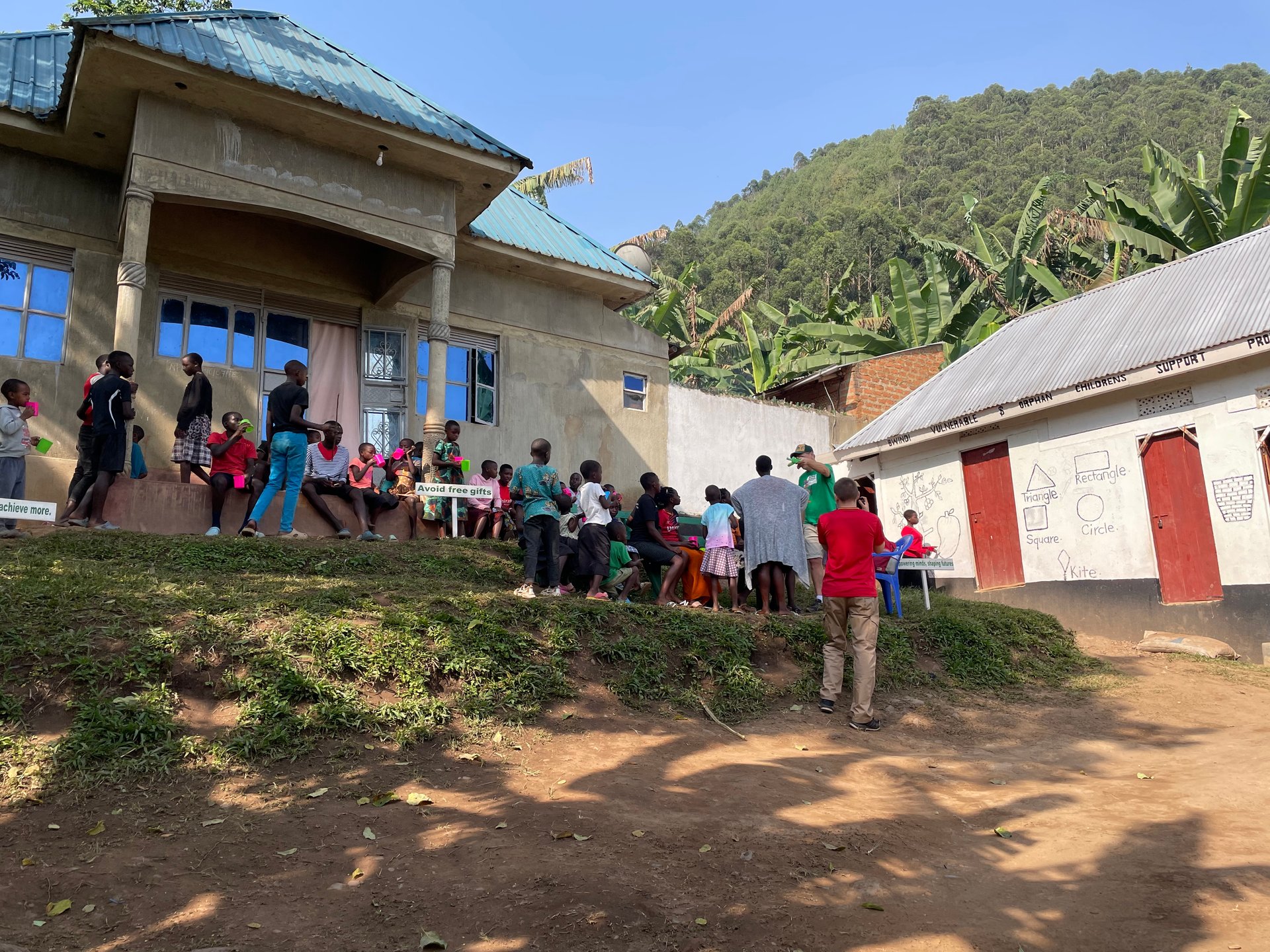
The orphanage in Buhoma looks larger from the road than it actually is. Step through the gate and the geometry becomes clear: a main building with three rooms, electricity but no running water, and a small annex containing a single dormitory and an office. Because the interior cannot hold everyone at once, the courtyard becomes the real living space — meals are served there, homework is done in the afternoon shade, games run until dark. Everything happens on that compound. During my visits to southwestern Uganda in October 2024 and January 2026, this kind of community infrastructure — small in scale, central in function — kept appearing as the organizing reality behind the region's tourism economy.
Lake Bunyonyi sits roughly 90 kilometers northeast of Buhoma, and the contrast in physical setting is complete. Where Bwindi is vertical and forested, Bunyonyi is a lake enclosed by layered hills, its surface broken by 29 islands and cut by channels narrow enough to cross by dugout canoe in a few paddle strokes. What the two places share is a version of the same question: how does the money that visitors spend translate into conditions like clean water, school fees, and reliable nutrition for the people who live alongside the attraction?
Lake Bunyonyi is one of Uganda's clearest cases of sustainable tourism done with practical intention rather than marketing language. The lake itself is unusual in the East African context — one of the few in the region confirmed to be free of bilharzia-carrying freshwater snails, making it genuinely safe for swimming. The community-based lodges that operate on its islands and shores have spent decades developing models that attempt to keep tourism revenue local. Understanding how those models work, and where they fall short, is the purpose of this article.
The Lake in Context: Geography, History, and What Makes It Distinctive
Lake Bunyonyi lies in Kabale District, close to the Rwandan border at an elevation of approximately 1,962 meters above sea level. It is Uganda's deepest lake, with some sections exceeding 40 meters. The depth, combined with the lake's slightly alkaline chemistry, creates conditions inhospitable to the Bulinus snail species that carry schistosomiasis — the parasitic disease that makes swimming in most East African lakes a genuine health risk. This is not a minor detail for travelers. It means Bunyonyi offers something genuinely rare: open-water swimming in sub-Saharan Africa without medical precaution.
The lake's 29 islands range from large enough to sustain a small community to barely large enough for a single lodge. The names carry history. Punishment Island, known locally as Akampene, was historically the site where unmarried girls who became pregnant were left to die — a practice that ended in the colonial period but which the island's name keeps in memory. Bushara Island, by contrast, became the site of one of Uganda's most cited community tourism projects, operated since the late 1990s in a model designed to funnel lodge revenue directly to surrounding villages. Ha'Buharo Island can be reached by motorboat in 35 minutes or by dugout canoe in approximately 90 minutes from the Rutindo landing on the western shore.
The Batwa, one of Uganda's indigenous forest-dwelling peoples, lived in and around the Lake Bunyonyi region long before the current Bakiga majority settled the surrounding hills. The displacement of Batwa communities from forest reserves — including areas around Bwindi — is a contested chapter in Uganda's conservation history. Some community tourism projects at Bunyonyi explicitly include Batwa cultural programming as a component of their visitor offerings, though the degree to which Batwa individuals benefit materially from those programs varies considerably.
Frank Kalimuzo and the Birdnest Resort: A Building with a History
The oldest standing accommodation on Lake Bunyonyi carries a specific political weight. The Birdnest Resort Bunyonyi was originally built by Frank Kalimuzo, who served as Vice Chancellor of Makerere University under President Obote. After Idi Amin seized power in a military coup in January 1971, Kalimuzo was among the intellectuals and officials who "disappeared" — the euphemism used at the time for state-sponsored murder. His wife found herself unable to maintain the lakeside property. Amin's forces occupied and used it, then abandoned it, and the building stood empty for more than three decades, deteriorating through the instability of the 1970s and 1980s.
Eventually, Kalimuzo's widow sold the property to Belgian buyers who undertook a careful restoration over several years. Today the Birdnest Resort offers 15 comfortably furnished rooms and seven cottages, all with lake views, plus a restaurant. Doubles and two-person cottages start at approximately $170–$190 including breakfast, with Wi-Fi and a swimming pool. It remains, according to local accounts, the first permanent structure built on the lake — and its history makes it arguably the most historically layered building in the Kabale region.
How the Lodge Spectrum Works: From Island Camps to Budget Stays
The accommodation range at Lake Bunyonyi is genuinely broad, which is one reason the lake draws a more economically diverse visitor than many of Uganda's wildlife destinations. The gorilla permit at Bwindi costs $800 per person for peak season and functions as a natural filter for high-spend travelers. Bunyonyi has no equivalent gatekeeping cost. A traveler with $25 per night can share a dormitory at the Bunyonyi Safari Resort; one with $190 per night can have a private lake-view cottage at the Birdnest. Both are looking at the same water.
Birdnest Resort Bunyonyi
Historic property, 15 rooms + 7 cottages, all with lake views, pool, restaurant.
From $170 / $190 (double/cottage), incl. breakfast
Bunyonyi Safari Resort
Three-story block, 40 rooms plus lake cottages. Long activity list: tennis, massage, sauna, canoe tours, birdwatching, bike hire.
From $25 single / $80 double / $100 cottage, incl. breakfast
Bunyonyi Lodge Kalebas
Terraced garden designed by 80-year-old owner Andrew Baliyampika. Small, character-driven property.
From $40 double, incl. breakfast
Bushara Island Camp
Cottages and safari tents on wooden platforms, island setting, canoe hire, guided birdwatching. Community-linked revenue model.
[RECHERCHE NOETIG: current rates]
The Bunyonyi Safari Resort illustrates a common pattern in Ugandan lake tourism: a property that began as a modest lakeside operation and expanded over time into something closer to a resort format, with a broad activity menu intended to justify multi-night stays. The list at Bunyonyi Safari runs from lawn tennis and jogging routes to massage, sauna, guided birdwatching, and canoe tours. The physical property — a three-story hotel block plus six lakeside cottages in landscaped gardens — reflects the tension between the "eco" branding common to lake tourism and the infrastructure requirements of a property trying to compete on comfort.
The Kalebas Lodge takes a deliberately smaller path. The property is most notable for its terraced garden, designed and maintained by its octogenarian owner, Andrew Baliyampika. At $40 for a double room including breakfast, it occupies the territory between budget and mid-range, and its garden — constructed over decades on a hillside above the lake — represents a kind of personal aesthetic commitment that larger properties cannot replicate.
Bushara Island Camp and the Community Model
Bushara Island Camp is the property most frequently cited in discussions of community-based tourism at Lake Bunyonyi. The camp offers cottages and safari tents on raised wooden platforms, with lake views, canoe hire, and guided birdwatching. What distinguishes it from other island lodges is the revenue-sharing structure that directs a portion of lodge income toward community programs in the surrounding villages — a model that was developed in the late 1990s with input from conservation organizations working in the region.
The Ha'Buharo Island camp, reachable in 35 minutes by motorboat or 90 minutes by dugout from Rutindo, takes a similar approach, combining accommodation with privacy — the source notes describe it as offering "much privacy" alongside a good restaurant and bar — with canoe rental and guided birdwatching as standard offerings.
[QUOTE: lodge manager or community tourism coordinator on how the revenue distribution works in practice]
It is worth being precise about what "community tourism" means in practice, because the term covers a wide spectrum. At the stronger end, it means meaningful ownership stakes, genuine employment of local residents in skilled rather than only service roles, and transparent accounting of how lodge revenue flows to community funds. At the weaker end, it means a lodge that donates to a local school once per year and uses the association in its marketing. Bunyonyi's better-known community properties sit toward the stronger end, but visitors who want to verify the model before booking should ask direct questions — how many local staff? what percentage of revenue reaches community funds? — rather than treating certification language at face value.
Tourism as Economic Infrastructure: What the Numbers Mean Locally
Uganda's tourism sector functions as one of the country's primary foreign exchange earners, generating employment across a wide range of skill levels and channeling investment into infrastructure that local populations use regardless of their connection to the tourism industry. Roads built or improved to reach Bunyonyi benefit local farmers moving produce to Kabale market. Electrical connections extended to lakeside lodges reduce the isolation of the hillside communities above them. Mobile connectivity installed for lodge guests improves communication options for everyone in range.
This diffusion of benefit is not automatic. In areas where tourism facilities are foreign-owned, where supply chains are dominated by goods imported from Kampala or abroad, and where skilled management positions are filled by non-local staff, the economic multiplier for local communities is low. The Lake Bunyonyi cluster of community-oriented lodges represents an explicit attempt to increase that multiplier by sourcing food locally, hiring from surrounding villages, and directing a share of revenue into defined community funds.
The Ankole region — of which the Lake Bunyonyi catchment area is broadly a part — has been the subject of tourism development assessments that identify visibility and marketing as primary constraints on growth. Well-run community camps at Bunyonyi, Kyabura, and the surrounding crater lakes have sometimes struggled to appear in the tour operator listings and online booking platforms where international visitors find their accommodation. This is a structural problem: smaller, locally-owned properties lack the marketing budgets to compete with international brands on search platforms, even when the on-ground experience they offer is superior.
Activities on the Lake: Canoes, Birds, and the Logic of Slow Travel
The most distinctive activity at Lake Bunyonyi is also its oldest. Dugout canoe travel — using the traditional wooden boats that have moved people and goods across these islands for generations — remains the primary means of inter-island transport for local residents, and it is available to visitors at most lodges. A canoe journey between islands, navigating the narrow channels and open bays, gives a ground-level perspective on the lake's geography that no motorboat crossing provides. The 90-minute paddle to Ha'Buharo Island from Rutindo is long enough to feel like genuine exploration rather than a hotel transfer.
Birdwatching at Lake Bunyonyi is a significant draw for visitors with ornithological interests. The lake and its surrounding papyrus margins support a range of species not easily observed in the drier parts of Uganda. Grey crowned cranes, African fish eagles, and multiple species of kingfisher are regularly reported by visiting birders. The altitude — close to 2,000 meters — means that some highland-specific species appear here that are absent from Uganda's lower-lying lakes. Guided birdwatching is available at most of the main lodges, though the quality of guides varies considerably.
Swimming is straightforward and safe, as noted above. The lake's surface temperature at this altitude is cool rather than warm — typically 18 to 22 degrees Celsius — which may come as a surprise to visitors arriving from the lowlands. The water is clear enough in most sections to see several meters depth from the surface.
Cycling has been identified in regional tourism assessments as an underdeveloped activity around the lake and surrounding hills, with the terrain — steep but varied, and largely free of heavy traffic — potentially well-suited to mountain biking. As of the time of writing, cycling infrastructure at Bunyonyi is limited to a few lodges offering bike hire for short rides; a developed trail network does not yet exist.
Practical Information: Getting There, When to Visit, and What to Budget
Lake Bunyonyi lies approximately 420 kilometers from Kampala by road. The route follows the Masaka Highway southwest before climbing into the hills above Kabale. The highway has been undergoing phased rehabilitation and expansion — sections of it were in active construction during January 2026, with stretches of compacted dirt and considerable dust alongside the paved lanes. For vehicles without air conditioning, and particularly for motorcycle riders, the dust is a genuine physical challenge in dry conditions. The full drive from Kampala to Bunyonyi takes six to seven hours under normal conditions; an overnight bus to Kabale, followed by a short morning transfer to the lake, is an alternative that avoids the worst of the daytime heat on the road.
From Kabale town, the lake is approximately eight kilometers by road to the main landing areas at Rutindo or Byoona Amagara. Motorcycle taxis (boda-bodas) and private hire vehicles both make the connection regularly.
The lake can be visited year-round, but the dry seasons — broadly December to February and June to August — offer the most stable road conditions and the clearest views across the water. The long rains (March to May) make the surrounding hills vividly green but can render unpaved sections of approach roads difficult for ordinary vehicles. When I visited in January 2026, the hills above the lake were dry-season gold, the roads to the shore were passable, and the lake surface was calm enough for long canoe crossings without difficulty.
Budget planning for Bunyonyi depends heavily on accommodation choice. A visitor staying at the Kalebas Lodge at $40 per night, eating at local restaurants, and hiring a canoe independently can move through the area on $60 to $80 per day. A guest at the Birdnest Resort, with meals on-site and guided activities, is looking at $250 per day or more. The mid-range cluster — Bunyonyi Safari Resort at $80 to $100 per night, with activities included — represents the volume of the market.
From the field
Frequently asked questions
What is Lake Bunyonyi known for?
Lake Bunyonyi is Uganda's deepest lake and one of the few in Africa free of bilharzia (schistosomiasis), making it safe for swimming and water activities. It is known for its 29 islands, narrow channels ideal for dugout canoe exploration, rich birdlife, and a growing cluster of eco-lodges and community tourism projects in the surrounding hills.
How do I get to Lake Bunyonyi from Kampala?
Lake Bunyonyi lies roughly 420 kilometers from Kampala, near the town of Kabale in southwest Uganda. The drive via the Masaka Highway takes approximately six to seven hours under normal conditions. Buses and minibuses from Kampala to Kabale run regularly; from Kabale, local transport or a short private hire transfers you to the lake shore at Rutindo or Byoona Amagara landing.
Is it safe to swim in Lake Bunyonyi?
Yes. Lake Bunyonyi is one of the very few lakes in Uganda — and in sub-Saharan Africa — confirmed to be free of bilharzia-carrying snails. Its depth and chemical composition do not support the snail habitats that enable schistosomiasis transmission. Local children swim in it daily, and lodges actively encourage guests to use the water.
What eco-lodges are at Lake Bunyonyi?
The range runs from the historic Birdnest Resort Bunyonyi ($170–$190 for a double with breakfast), rebuilt after Idi Amin's forces used and abandoned it, to the mid-range Bunyonyi Safari Resort ($25–$100 depending on room type) and the Kalebas Lodge ($40 double including breakfast). Bushara Island Camp, operated on a community basis, is one of the region's most frequently cited examples of tourism revenue flowing directly back to local families.
Can you visit Lake Bunyonyi after gorilla trekking in Bwindi?
Yes, and most visitors who come to southwest Uganda for gorilla trekking combine the two. Bwindi Impenetrable National Park and Lake Bunyonyi are roughly 90 kilometers apart, connected by a road through Kabale. A one or two-night stay at the lake is a natural complement to the physical demands of a gorilla trek, and the two destinations work well together without excessive driving.