Overview
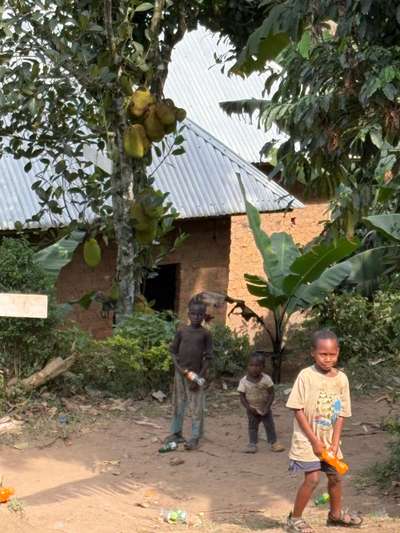
On June 21, 2026, I photographed children near the orphanage in Buhoma — a village at the western edge of Bwindi Impenetrable National Park. They were hesitant, their appearance signaling that something at home was not right. We invited them to eat with us. The informal, immediate gesture — noticing a gap and responding — is something that also describes how Uganda's refugee system was built: through repeated, pragmatic responses to successive displacement crises, accumulated into a framework that now coordinates 96 organisations across a two-million-person caseload.
The Uganda Country Refugee Response Plan is that framework. It is the planning, coordination, and fundraising architecture through which Uganda's refugee response is managed. The UCRRP sets out what needs to be done — sector by sector, district by district — calculates the cost, appeals to international donors for funding, and tracks implementation against objectives. In 2024, the appeal came to USD 857 million. Donors provided USD 391 million. What happened to the work that the other USD 466 million was supposed to fund is the story this article tells.
Ninety-six organisations is a large number. Coordination at that scale is not automatic. The UCRRP operates through a cluster system — each sector (food, health, education, water and sanitation, shelter, livelihoods, protection) has a lead agency and a coordination mechanism. Meetings, reporting systems, shared databases, and joint monitoring frameworks allow agencies to avoid duplication, identify gaps, and allocate available resources where they are most needed. The Office of the Prime Minister — Uganda's lead government body for refugee affairs — chairs the overall coordination structure.
A Decade of Widening Gaps
The UCRRP funding gap in 2024 was not exceptional. It was consistent with a decade-long trend. In 2021, the plan received roughly 60% of its request. In 2022 and 2023, coverage declined further. By 2025, the plan was receiving approximately 22% of what it requested — meaning nearly four fifths of planned activities were unfunded. The refugee population over this period grew from approximately 1.5 million to over 2 million. More people, less money per person: the arithmetic of the funding gap compounds over time.
The consequences are not hypothetical. They are documented in the monitoring system that the UCRRP's Underfunded Indicators Tracking Dashboard makes visible. Drug stockouts at health facilities: 73% affected. Long wait times at health facilities: increased from 30% to 45% of visits in a single year. These indicators are direct outputs of underfunded health sector budgets. When medicines are not purchased because funding did not arrive, clinics have no drugs to dispense. When health worker posts go unfilled because salaries cannot be paid, patient queues grow longer.
The 2025-2026 UCRRP increased its total requirement to USD 968 million — up from USD 857 million in 2024 — reflecting both the continued growth of the refugee population past two million and rising operational costs across all sectors. Against a backdrop where the 2024 plan received only 46 percent of its request, the larger 2025 appeal represents an even steeper funding challenge. The gap between what is required and what is likely to be received has widened in absolute terms even as donors' contributions have stagnated or declined.
Food rations have been the most visible casualty of repeated funding shortfalls. The World Food Programme — which coordinates food provision across Uganda's settlements — has cut rations multiple times in response to insufficient contributions. In some settlements, rations fell to 50% or below of the 2,100-calorie daily standard. Refugee households receiving half their intended food provision must make up the difference from their own resources — farming, casual labor, asset sales — or go hungry.
Sectors and Their Lead Agencies
Within the UCRRP, each sector operates through its own coordination structure. Food security is led by WFP, which is also the primary operational agency for food provision. Health is led by WHO and UNHCR jointly, with implementation by partners ranging from international medical NGOs to Uganda's Ministry of Health. Education involves UNICEF, UNHCR, and the Ministry of Education. Livelihoods — the sector that invests in long-term economic integration — is led by UNHCR with contributions from development-oriented partners including bilateral development agencies.
Protection — the sector that addresses the legal, physical, and psychological safety of refugees — operates across multiple sub-clusters: child protection, gender-based violence prevention and response, legal assistance, and community protection. Protection activities are often invisible from the outside but foundational: without documentation, refugees cannot access services. Without GBV response, survivors remain at risk. Without community protection mechanisms, disputes escalate rather than resolve.
The 96 partners range from large international organisations with hundreds of staff to small national NGOs with specific expertise and community trust that international agencies cannot replicate. The coordination system attempts to align these actors around shared priorities while respecting their mandates and allowing for operational flexibility. It does not always succeed — coordination systems create transaction costs, and agencies with different accountability structures and timelines do not always align naturally — but the alternative, uncoordinated parallel operations, would produce far worse outcomes.
Integration with Development: The UCRRP's Evolution
One of the most significant shifts in Uganda's refugee response over the past decade has been the integration of development programming alongside humanitarian response. Early UCRRP iterations were purely humanitarian — designed to meet immediate needs. The current model explicitly aims for a development-humanitarian nexus: addressing immediate needs while simultaneously investing in systems and capabilities that will reduce future humanitarian requirements.
This means including livelihoods programming that connects refugees to job markets rather than only distributing food. It means working with Uganda's Ministry of Health to strengthen district health systems — not just funding parallel refugee-specific health services, but building capacity that benefits everyone. It means investing in water infrastructure that serves both refugee and host communities rather than building separate refugee-only systems.
The eight Market Systems Development programmes active in Uganda in late 2024 reflect this philosophy. Rather than distributing inputs to refugee farmers, MSD programmes invest in the agricultural markets, aggregation networks, and financial services that farmers — refugee and Ugandan alike — use. When the programme ends, the market improvement persists. This is a more efficient use of limited resources than recurring input distribution.
What International Burden-Sharing Requires
Uganda's UCRRP funding gap is not primarily a management problem. The UCRRP coordination architecture is well-designed by global standards. The problem is that the international community has allocated its humanitarian budgets in ways that systematically under-resource Uganda's response relative to what it actually costs to serve two million people adequately.
Burden-sharing — the principle that countries hosting refugees should receive proportional international support — has been a stated commitment in successive global refugee frameworks, including the Global Compact on Refugees adopted in 2018. Implementation has consistently fallen short. Uganda, which hosts the world's largest refugee populations per capita income, receives less international support per refugee than less challenging hosting contexts.
The gap between principle and practice has concrete consequences visible in the monitoring data: drug stockouts, reduced rations, crowded classrooms, inadequate water. It also has a longer-term consequence that is less measurable but equally important: the erosion of Uganda's political will to maintain its progressive refugee policy. A country that bears genuine sacrifice to host refugees while receiving inadequate international support is a country whose political calculus on refugee hosting can shift. The UCRRP's funding gap is not just a humanitarian problem — it is a risk to one of the world's most important refugee hosting frameworks.
From the field
Frequently asked questions
What is the Uganda Country Refugee Response Plan?
The UCRRP is the coordinating framework for Uganda's refugee response, uniting 96 partner organisations — UN agencies, international NGOs, Ugandan civil society, and government bodies — across all sectors including food, health, education, water, livelihoods, and protection.
How much funding did the UCRRP receive in 2024?
The UCRRP requested USD 857 million in 2024 and received USD 391 million — 46% of the request, leaving a 54% funding gap. This chronic underfunding directly reduces food rations, drug availability, and livelihoods programming across Uganda's refugee settlements.
How many organisations participate in the UCRRP?
96 partner organisations participate in the UCRRP, including UNHCR, WFP, UNICEF, WHO, international NGOs, Ugandan civil society organisations, and the Office of the Prime Minister — Uganda's lead government body for refugee affairs.
What sectors does the UCRRP cover?
The UCRRP covers food security, nutrition, health, education, water and sanitation, shelter, livelihoods, protection, social cohesion, and coordination. Each sector has its own plan, lead agency, and funding requirements within the broader annual appeal.
What happens when UCRRP funding falls short?
Underfunding leads to reduced food rations, drug stockouts at 73% of health facilities, long wait times at 45% of health visits, reduced education support, and scaled-back livelihoods programming. It also undermines long-term market systems investment that would reduce future aid dependency.