Overview
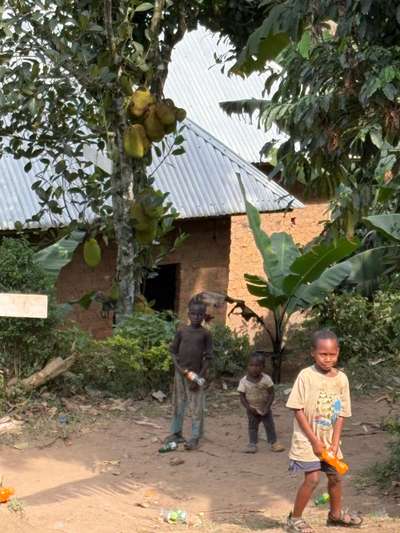
In Buhoma on June 21, 2026, I photographed children from the neighborhood near the orphanage. They came over hesitantly. Something about their appearance — clothing, posture, the quality of their attention — was conspicuous. We invited them to eat with us. Asked what they wanted for their future, the answers were simple: school, work, a house. Basic aspirations. The gap between what they wanted and what the current trajectory of their lives seemed to offer was visible, if not yet fully formed as pessimism. In Uganda's border communities, for the adults who have been in the system for years, that gap has become fully formed.
The Uganda Situation Monitoring Initiative's March 2026 report contains a finding that is diagnostically important precisely because it is not a crisis signal. Of 501 respondents surveyed in Uganda's border areas, 64.6% reported stable current conditions — food, shelter, physical safety at a basic manageable level. Those same respondents also reported lower optimism about the future than other groups. Stable but pessimistic. This is the largest single segment in the survey data, and its combination of present adequacy and future hopelessness is a signal that warrants attention from anyone working on durable solutions for displaced populations.
The hope-reality gap matters because hope is not merely an emotional state. It is a cognitive resource that affects decision-making, investment behavior, and resilience. People who believe their situation can improve invest in that improvement: they send children to school, build more permanent shelter, develop businesses, participate in community governance. People who believe their situation cannot improve stop investing. They manage the present while expecting the future to be the same or worse.
Reading the Stable-Pessimistic Profile
The stable-pessimistic profile is not a contradiction. It describes a specific and recognizable situation: a household that has found a workable equilibrium — enough food from the plot, a roof that does not leak, children in school — but that can see no pathway forward from that equilibrium. The structural conditions that would enable improvement — more land, better market access, legal status clarity, economic mobility pathways — are absent. The situation is sustainable in the short term and offers no prospect of change.
This profile contrasts with two other common categories in displacement monitoring data. The unstable-pessimistic group is in crisis — current conditions are bad and they expect them to remain bad. The stable-optimistic group has current adequacy and believes improvement is possible. The stable-pessimistic group is the one hardest for humanitarian programming to reach: they are not in acute need, so they score below the thresholds that trigger targeted assistance, but they are not well enough to invest in their own improvement.
For humanitarian actors, the stable-pessimistic segment signals something specific about the quality of the response. A system that produces stable households but not hopeful ones — that meets immediate needs but does not create pathways — is doing its most basic job but not its full one. The UCRRP's commitment to a development-humanitarian nexus is precisely intended to address this: moving beyond keeping people alive to enabling them to live with possibility.
Structural Drivers of Border Pessimism
Several structural factors converge to produce the stable-pessimistic profile in Uganda's border communities. Land is the most fundamental. Refugees allocated land in settlements generally received smaller and less fertile plots as settlement populations have grown. New arrivals after 2020 in many established settlements received plots that were already marginal. The prospect of expanding agricultural output — the primary pathway to economic improvement in the settlement system — is limited by land availability that is not going to increase.
Legal status uncertainty compounds the land issue. Refugees in Uganda have the right to work and move, but their long-term legal status is not settled. The possibility of forced return, uncertainty about whether Uganda will eventually grant permanent residence or citizenship to long-term refugees, and the lack of clarity about what happens to land rights if a household head dies — these uncertainties make multi-year investment rational to defer. Why build a permanent structure or plant a fruit tree if the future of your right to be here is unclear?
The education system — critical for the next generation's prospects — is accessible but constrained by quality. Schools near large settlements are overcrowded. Teacher salaries are inadequate, turnover is high, and instructional quality suffers. Children who complete primary school in a settlement may not have the skills that secondary school or employment requires. Parents who invest in school fees see children graduate into a local economy with limited formal employment, reinforcing the sense that investment does not produce improvement.
The Health System Signal
The operational indicators for Uganda's settlement health system in 2026 provide a specific illustration of what stable-but-pessimistic looks like institutionally. Health facilities are functioning — they are open, staffed, treating patients. But drug shortages affect 73% of facilities. Wait times are elevated for 45% of patient visits. Workers are burning out from managing high patient loads with inadequate supplies.
From a community perspective, the health system is stable in the sense that it exists and is accessible. But it is not adequate — the repeated experience of attending a clinic and being told there is no medicine is an experience of a system that is present but cannot actually help. Repeated experiences of institutional inadequacy contribute directly to pessimism about whether the situation will improve. If the system has been unable to maintain drug supplies for years, why would it suddenly improve?
The same logic applies across sectors. Ration cuts that have happened multiple times over the past decade; livelihoods programmes that start, run for a year or two, and then end when funding expires; community services that are inconsistently available. The cumulative experience of promises that were not kept, or kept imperfectly, builds into a generalized pessimism that is entirely rational given the evidence.
Migration Implications
The stable-pessimistic profile has specific implications for secondary migration — movement within Uganda or onward to third countries. People in acute crisis move because they must. People who are stable but hopeless move because they calculate that change itself is the only available pathway to improvement. When staying offers safety but no prospect of advancement, and moving offers risk but at least the possibility of something different, the migration calculus shifts toward movement.
Secondary migration from Uganda's settlements to Kampala, to other African countries, or toward Europe via the Central Mediterranean route, is driven partly by this dynamic. The border monitoring data that produces the 64.6% finding is measuring a population at the stage before that decision is made — stable, managing, but looking at the future and not finding a reason to stay committed to the current trajectory.
This is not an argument that people should stay — movement is a legitimate response to structural limitation. It is an argument that if the humanitarian and development system wants to build communities that invest in their own futures in Uganda, producing stability is necessary but not sufficient. The stable-pessimistic finding is a monitoring signal that the system is half-succeeding and should be read as a call to address the structural factors — land, legal clarity, economic mobility, education quality — that determine whether stability becomes hope.
From the field
Frequently asked questions
What is the hope-reality gap at Uganda's borders?
The hope-reality gap describes the finding from a March 2026 migration survey: 64.6% of respondents (N=501) reported stable current conditions but lower optimism about the future. This is the largest single segment in the data, signalling structural livelihood and future-prospects issues beyond immediate security concerns.
What does stable but pessimistic mean in the border context?
Stable means current conditions — food, shelter, physical safety — are maintained at a basic level. Pessimistic means respondents do not believe their situation will improve. This combination signals chronic structural limitation that forecloses hope, with direct implications for migration decisions, mental health, and community investment behaviour.
What border areas does this data cover?
The Uganda Situation Monitoring Initiative March 2026 survey covers border areas including the Uganda-DRC and Uganda-South Sudan corridors, capturing both refugee and host community respondents in borderland zones experiencing the most direct effects of regional conflict and displacement.
How does the hope-reality gap relate to migration decisions?
People who are stable but hopeless face a specific migration calculus: staying is manageable but offers no prospect of improvement; moving involves risk but offers the possibility of change. This tends to generate secondary migration — within Uganda or onward — rather than crisis-driven immediate flight.
What structural factors drive pessimism despite stability?
Key structural factors include: limited land availability constraining agricultural improvement; legal status uncertainty discouraging long-term investment; inadequate education quality limiting next-generation prospects; and repeated experiences of institutional failure (ration cuts, drug shortages, programme discontinuation) that rationally justify pessimism about future improvement.