Overview
Uganda's poverty rate has declined substantially since the early 1990s, but the Uganda National Household Survey 2023/24 makes clear that the challenge remains substantial and unevenly distributed — with rural households, female-headed households, and communities in northern Uganda bearing disproportionate poverty burdens. The rate tells you where a country stands; what it does not tell you is how it gets from there to somewhere different. That question — what actually works to move households out of poverty durably, not just temporarily — is what Uganda's poverty reduction programme landscape attempts to answer.
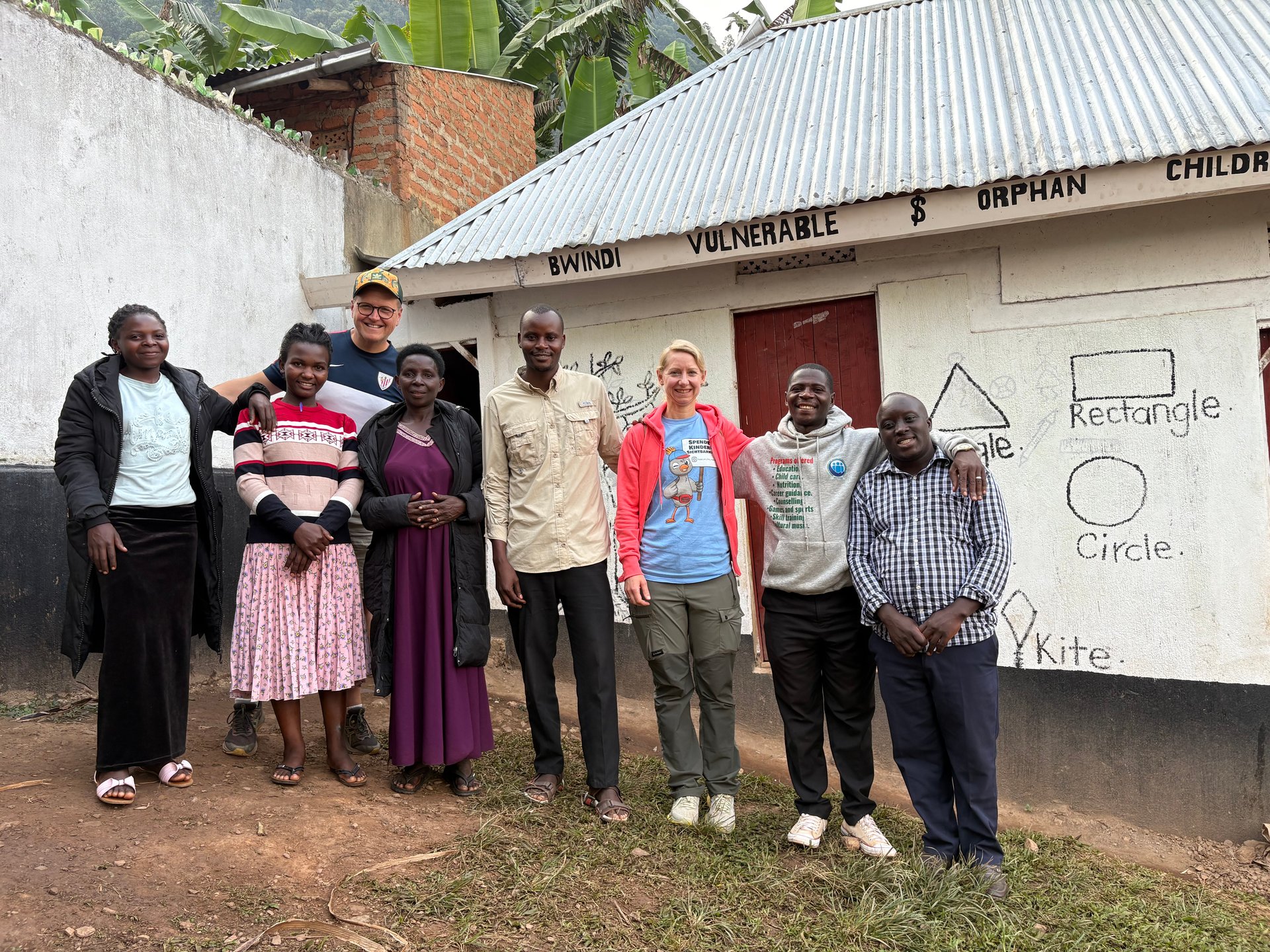
On 21 June 2026 I was in Buhoma in the Kigezi highlands of southwestern Uganda, at GPS coordinates 0.9617°S, 29.6109°E — photographs taken that morning, verified. Three children from the neighbourhood of the local orphanage arrived at the edge of a meal we were preparing. They were shy, and clearly not doing well. Their clothes and manner both carried markers of genuine difficulty. We invited them to eat with us immediately; they hesitated briefly and then came. I have made fourteen documented visits to Uganda — twelve days in October 2024, eleven days in January 2026, thirteen days in May 2026, plus shorter visits in April and June 2026 — and these moments of direct proximity to poverty keep recalibrating what the data means. The children in Buhoma that day were not the intended beneficiaries of a poverty programme. They were the unintended remainder — present, visible, not reached.
This article examines the programmes designed to reach people like them: the Graduation Programme model and its four-component structure, SYPO Uganda Ltd. and its micro-lending in remote communities, the SUPREME youth enterprise project, and the Rural Finance Initiative that bridges Uganda and South Sudan. These are not theoretical constructs. They are operational systems with documented track records — and understanding how they work is essential context for anyone trying to understand what Uganda's development trajectory actually looks like from the ground.
The Graduation Programme: A Four-Component Model
The Graduation Programme is a structured poverty graduation model built on the premise that ultra-poor households cannot climb out of poverty through a single intervention. They need simultaneous support across multiple dimensions — economic, financial, social, and protective — delivered in a coordinated sequence over a defined timeframe. The model was originally developed by BRAC in Bangladesh and is now one of the most rigorously tested poverty reduction approaches in sub-Saharan Africa, including Uganda.
In Uganda the Graduation approach has been implemented across refugee settlements and host communities through UNHCR partnerships and national social protection programmes. The four components are delivered together rather than sequentially, because the constraints they address are interdependent: a household that receives an asset transfer but lacks financial literacy will not sustain the asset; a household that receives social protection transfers but lacks livelihood training cannot build on the transfer; a household that has both but faces social isolation — stigma, gender-based violence, lack of community networks — cannot access markets or enforce contracts.
The evidence base for the Graduation approach in Uganda is reviewed through the lens of the Joint Livelihoods Integration and Response Programme (JLIRP), which applied a graduation-aligned model across refugee-hosting districts. Its endline evaluation found that 40.3 percent of households had established or expanded a business within three years of programme participation — with the combination of skills training and financial support consistently outperforming either element delivered in isolation.
Graduation in Refugee Settlement Contexts
Uganda's refugee settlements — including Lobule Refugee Settlement (DRC and South Sudanese population) and Rhino Refugee Settlement (South Sudanese and DRC population) — present both an opportunity and a stress test for the Graduation model. The opportunity is that settlements concentrate high-poverty, high-need populations in defined geographic areas, making programme delivery more efficient than dispersed rural coverage. The stress test is that the structural constraints facing refugees — legal barriers, language differences, disrupted social networks, documentation gaps — add dimensions that the original Graduation model was not designed for.
The adaptation for displacement contexts has involved extending programme timelines (refugees typically need longer to rebuild social networks than host community members), integrating psychosocial support alongside economic programming, and ensuring that financial products are accessible to people without the documentation that standard microfinance institutions require. The Uganda Country Refugee Response Plan, coordinated through UNHCR, provides the framework within which these adaptations are implemented and monitored.
In November 2024, a U-Learn assessment identified eight visible Market Systems Development (MSD) programmes operating in Uganda's refugee response context, with seven targeting agricultural markets and two implementing a full graduation approach. The agricultural market focus reflects the fact that farming — rainfed crop production in particular — remains the primary livelihood activity for both refugee and host community households in Uganda's northern and western settlement districts.
Stichting SYPO and SYPO Uganda: Microfinance at the Last Mile
Stichting SYPO is a Dutch NGO whose social enterprise arm, SYPO Uganda Ltd., operates as a microfinance institution in areas that the commercial banking sector and mainstream microfinance institutions do not reach. The distinction matters: most microfinance in Uganda is clustered in or near district towns, where population density justifies the operational cost of branch infrastructure. SYPO's model is designed specifically for remote communities — places where the nearest bank is a two-hour journey and where loan officers from conventional institutions do not regularly travel.
SYPO Uganda offers small loans calibrated to the capitalisation needs of micro-enterprises: the amount needed to buy a sewing machine, to stock a small shop for the first time, to purchase the improved seeds that can double a smallholder's yield for a season. These are not large sums by international standards — often USD 50 to USD 300 — but they are transformative for households that have no other route to startup capital and for whom a commercial bank loan application is completely inaccessible.
The model links credit to training and ongoing support rather than delivering loans as standalone products. A borrower from SYPO Uganda is expected to participate in a financial literacy module before receiving their first loan, and loan officers conduct follow-up visits to monitor business progress and provide simple business advisory support. This combination — credit plus training plus follow-up — is what the evidence base shows consistently produces better outcomes than credit alone.
SYPO in the Refugee Context
SYPO Uganda's operations extend into refugee-hosting areas, where the combination of last-mile reach and displacement-adapted products is particularly valuable. Refugees in Uganda's western and northern settlements face a specific financial inclusion barrier: they are legally permitted to operate businesses and own assets under Uganda's Refugees Act 2006, but they often lack the collateral documentation, local credit history, and stable address history that conventional microfinance institutions require for lending.
SYPO Uganda's group lending model — in which small groups of borrowers provide social collateral for each other, with joint liability for repayment — partially addresses this barrier by substituting peer accountability for physical collateral. The group model also builds the social networks and trust relationships that the Graduation Programme's "social strengthening" component targets: borrowers who meet regularly to manage their loan group develop commercial relationships, share market information, and provide informal insurance to each other against shocks.
[QUOTE: SYPO Uganda borrower or loan officer on how the group lending model works in practice — to be collected on next visit to a northern or western Uganda settlement]
The SUPREME Project: Youth, Skills, and Enterprise
SUPREME — a youth empowerment initiative operating in Uganda — targets the specific failure mode of skills-only training programmes: graduates who have a certificate but no startup capital, no market connections, and no ongoing support, and who therefore return to subsistence farming or informal casual labour rather than applying their training. This failure mode is well-documented in Uganda's development literature. The JLIRP endline evaluation explicitly identified it as a critical constraint: "vocational training without follow-up financial and institutional support produces underemployment rather than sustainable enterprise."
SUPREME addresses this by providing three linked interventions: skills development (vocational training in market-relevant trades), entrepreneurship support (business planning, market analysis, enterprise management), and access to finance (startup capital, either as grants or through linkage to microfinance partners). The three elements are designed to be delivered together, though in practice the sequencing and integration vary by implementing partner and local context.
Uganda's demographic profile makes youth enterprise programmes a strategic priority. With a median age of 16 years — one of the youngest populations in the world — and a population growing at 3.1 percent annually (projected to reach 100 million by 2050 according to the Uganda Reiseführer 2020), the country faces the challenge of creating productive employment for a massive, rapidly growing young labour force. The formal employment sector cannot absorb this growth at anything like the required scale. Self-employment and micro-enterprise — the territory that SUPREME targets — are where the majority of Uganda's young population will build their economic lives.
Youth Employment in Uganda's Statistical Profile
The National Human Resource Survey 2023, one of the 22 official sources in the Uganda Insights knowledge base, documents the employment profile of Uganda's working-age population in detail. Youth unemployment and underemployment — particularly among young people with some secondary education who cannot find formal employment but have not yet established viable enterprises — represent a structural challenge that programmes like SUPREME are designed to address.
The Tourism sector provides one significant youth employment pathway: the Uganda Bureau of Statistics Statistical Abstract 2014 documents that the sector employs 200,000 people directly and a further 284,000 indirectly. The Uganda Wildlife Training Institute (UWTI) graduated 62 students in 2012/13 (47 male, 15 female) and enrolled 121 students in 2013/14 — a 24.8 percent increase — in wildlife management training that feeds directly into the park management and lodge operations employment market. Total tourism-related graduates between 2009 and 2013 numbered 10,679, according to the Statistical Abstract 2014. For young Ugandans in the southwest — the Kigezi highlands, the Bwindi corridor — tourism provides an employment pathway that connects directly to their geographic location and to the conservation economy that the national park system generates.
The Rural Finance Initiative: Cross-Border Financial Inclusion
The Rural Finance Initiative is a cross-border microfinance institution serving refugees and local communities in both Uganda and South Sudan. Its geographic scope distinguishes it from purely Uganda-focused programmes: it operates across the political border that separates two countries between which several hundred thousand refugees have moved, and will likely move again.
The cross-border design reflects a documented economic reality. Refugee households maintain economic ties across borders even when physical movement is restricted or unsafe: remittances flow from Uganda to family members remaining in South Sudan or DRC; cross-border trade in agricultural products and manufactured goods is conducted by traders who hold economic relationships in both countries; savings accumulated in Uganda are sometimes sent home during periods of relative stability or used to support return migration when conditions allow.
Financial products that cannot accommodate these cross-border transactions are structurally mismatched to the actual economic behaviour of the population they are designed to serve. The Rural Finance Initiative's cross-border model attempts to close that gap — providing financial services that recognise and accommodate mobility rather than treating refugees as a bounded, static population with the same financial behaviour as settled domestic households.
What the Programme Landscape Reveals About Uganda's Poverty Challenge
The variety and scale of Uganda's poverty reduction programme ecosystem — Graduation, SYPO, SUPREME, Rural Finance Initiative, plus the broader social protection architecture — reflects the multidimensional character of the poverty that the Uganda National Household Survey 2023/24 documents. Income poverty (measured against the national poverty line) is only one dimension. Asset poverty, educational poverty, health poverty, and social poverty — isolation, discrimination, exclusion from decision-making — interact with income poverty in ways that make single-intervention programmes consistently underperform.
The Graduation model's four-component structure is, in this reading, an acknowledgement of that multidimensionality: it is not clever to deliver four components simultaneously, it is necessary. The evidence base, built over twenty years of randomised controlled trials and programme evaluations in multiple countries, supports this conclusion. The challenge in Uganda is not the model but the delivery at scale — reaching the households that are most deeply poor, in the most remote locations, with the sustained engagement that graduation requires, at a cost that is sustainable within the available programme budgets.
Uganda's population of 46 million — growing at 3.1 percent annually, with 77 percent rural and a median age of 16 — means that the poverty reduction programmes currently operating are reaching a significant but still minority fraction of the population that needs them. The children in Buhoma that June morning, standing at the edge of a meal being shared at GPS coordinates 0.9617°S, 29.6109°E, were not the target population of a graduated programme or a SYPO loan cycle. They were visible, immediate, and not yet reached. That gap is not a programme design failure. It is a scale problem — and scale, in Uganda's development landscape, is always the hardest dimension to close.
Frequently asked questions
What is the Graduation Programme in Uganda?
The Graduation Programme is a four-component approach combining social protection (consumption support), economic strengthening (asset transfer and livelihood training), financial inclusion (savings groups and credit access), and social strengthening (coaching, mentoring, and peer networks). It was developed by BRAC and adapted for sub-Saharan Africa; in Uganda it is implemented across refugee settlements and host communities through UNHCR partnerships and national social protection programmes. The model is based on two decades of rigorous evaluation showing that simultaneous multi-component support outperforms single-intervention approaches for ultra-poor households.
What does SYPO Uganda do?
SYPO Uganda Ltd., the social enterprise arm of the Dutch NGO Stichting SYPO, provides microfinance in remote Ugandan communities that commercial banks and mainstream microfinance institutions do not reach. It uses a group lending model — groups of borrowers provide social collateral for each other — and links credit to financial literacy training and business advisory follow-up. Its target population includes refugee households and rural communities in the northern and western districts of Uganda.
What is the SUPREME project Uganda?
SUPREME is a youth empowerment initiative providing linked skills development, entrepreneurship support, and access to startup finance for young people in Uganda. It addresses the documented failure mode of skills-only training: vocational graduates who return to informal labour because they have certificates but no capital, market connections, or ongoing support. The project operates within Uganda's National Development Plan framework and targets both Ugandan youth and young refugees in settlement areas.
How effective are microfinance programmes in reducing poverty in Uganda?
Evidence in Uganda is context-dependent. Standalone credit without business support tends to produce consumption smoothing rather than enterprise growth. Programmes that combine credit with training, savings groups, and ongoing mentoring — as SYPO Uganda and the Graduation Programme do — show more consistent movement toward durable household economic resilience. The JLIRP endline evaluation found 40.3% of participating households had established or expanded a business within three years, with combined skills-plus-finance support consistently outperforming skills training alone.
What is the Rural Finance Initiative Uganda?
The Rural Finance Initiative is a cross-border microfinance institution serving refugees and local communities in both Uganda and South Sudan. Its cross-border design addresses the reality that refugee households maintain economic ties — remittances, cross-border trade, family support — across the Uganda-South Sudan border, and that financial products designed only for settled domestic populations are structurally mismatched to displaced communities with mobile economic lives. The Initiative operates within the UNHCR partner network supporting economic self-reliance in Uganda's northern settlements.