Overview
Uganda hosts more than 1.5 million refugees and operates under a legal framework — the Refugees Act 2006 — that grants them the right to work, move freely, and own land. This is not incidental: the principle that underlies Uganda's entire refugee response is that economic independence, not indefinite aid, is the correct goal. The four livelihoods stories documented in UNHCR's 2025 annual report are not exceptional cases. They are the intended outcome of a system built deliberately to produce them.
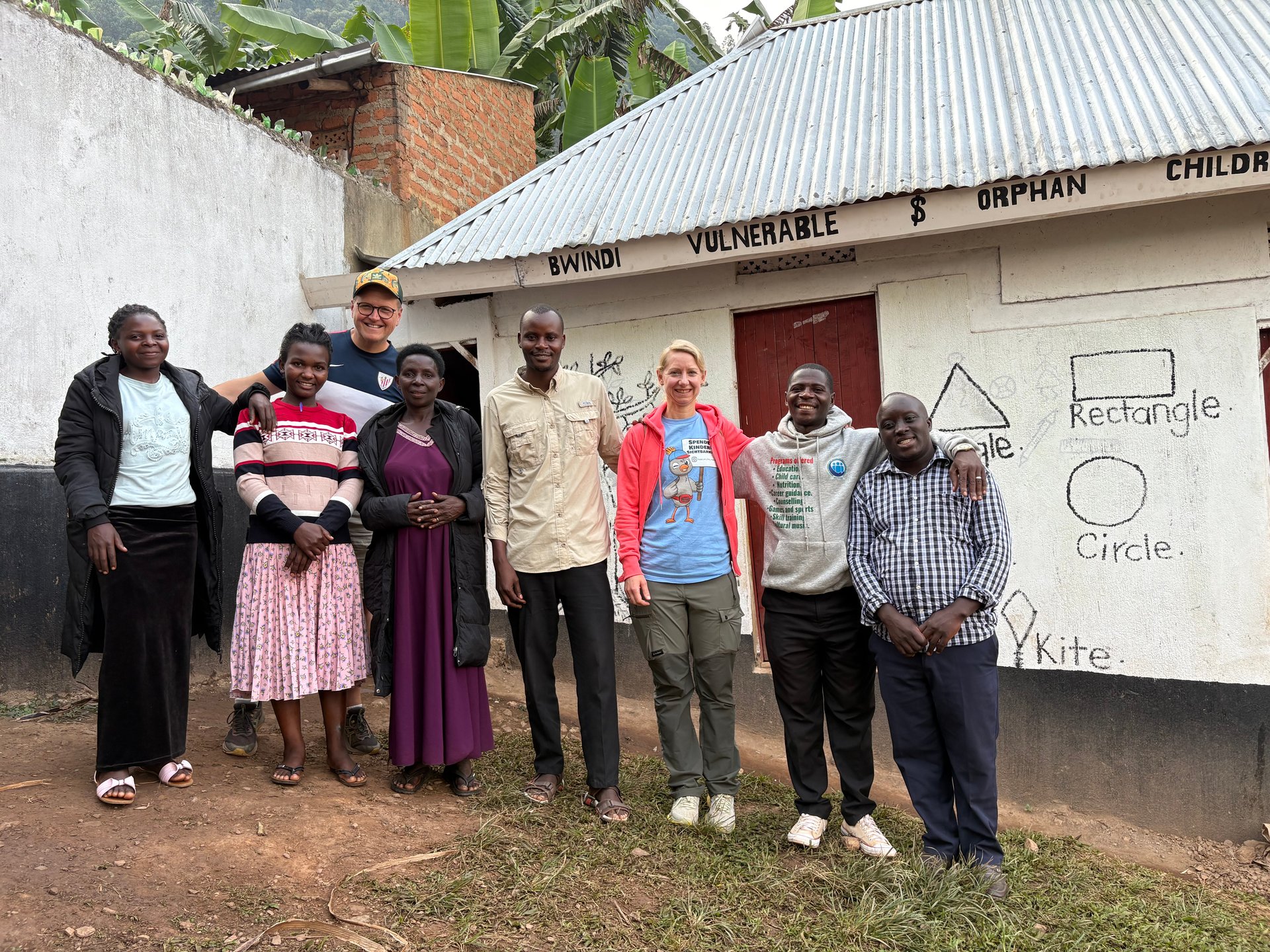
I visited Buhoma in June 2026 — GPS coordinates confirmed at 0.9617°S, 29.6109°E, photographs taken on 21 June 2026. Three children from the neighbourhood of the local orphanage appeared at the edge of a meal being prepared. They were shy, and clearly not doing well — their clothes and behaviour were both noticeably difficult. We invited them to join us immediately. They hesitated for a moment, then did. I have been to Buhoma three times now, most recently in June 2026 and before that in January 2026, and these moments of daily proximity to need are what make abstract statistics about "refugee livelihoods" concrete. The children that afternoon were not refugees in the formal sense. But the structural conditions that produce their circumstances — displacement, poverty, dependence on external support, disrupted families — are precisely the conditions that Uganda's comprehensive refugee response is trying to interrupt before they become permanent.
This article follows four people who interrupted those conditions for themselves. Their stories come from UNHCR's documentation work; the framework that made their stories possible comes from a decade of Ugandan policy that the rest of the world is only beginning to study seriously.
Uganda's Approach to Refugee Livelihoods
Uganda's Comprehensive Refugee Response Programme (UCRRP), managed by UNHCR, operates from a principle that distinguishes it from the emergency-focused refugee management systems common elsewhere: it treats refugees not as a temporary burden requiring containment but as a population with economic potential requiring integration. This is not a rhetorical position. It has structural consequences.
Refugees in Uganda are allocated land in settlements — typically between 30 and 50 decimals per household — and are legally permitted to cultivate it, sell produce, operate businesses, and access local markets on the same terms as Ugandan citizens. Reception centres manage new arrivals, with Imvepi Reception Centre holding capacity for 900 individuals, Ocea Reception Centre for 850, and Sebagoro Transit Centre for 1,230. These are temporary staging points: the system's goal is to move people through them into productive settlement life as quickly as possible.
Matthew Crentsil, UNHCR's Representative in Uganda, oversees a coordination structure that links government agencies, UN bodies, international NGOs, and — critically — refugee-led organisations. Filippo Grandi, UN High Commissioner for Refugees, visited Uganda in October 2024 specifically to assess the country's model, which has attracted international attention as a potential template for the broader global response to displacement. His visit focused on whether the integration approach is producing measurable outcomes — and the evidence from the field suggests it is.
The data above comes from the endline evaluation of the Joint Livelihoods Integration and Response Programme (JLIRP), which ran across refugee-hosting districts in Uganda with the goal of reducing aid dependency through skills training, agricultural improvement, and enterprise development. The results are significant not because they describe dramatic transformations — the businesses involved are mostly small-scale, low-capital ventures — but because they describe a direction of movement. People who were consuming aid are producing surplus. That shift is the programme's core logic.
The Role of Vocational Training
Windle International, one of UNHCR's key implementing partners in Uganda, provides vocational training sponsorship for refugees across multiple settlements. The training covers a practical range of skills — tailoring, mechanics, construction trades, food processing, ICT — and is explicitly designed to be market-relevant rather than certificate-oriented. The JLIRP evaluation found that trained youth had opened workshops, salons, and garages within settlement boundaries, and that some had begun employing others — a second-order economic multiplier that the programme's designers had targeted from the start.
The evaluation also identified the critical constraint: vocational training without follow-up financial and institutional support produces underemployment rather than sustainable enterprise. The skill exists; the startup capital does not. Organisations like SYPO Uganda Ltd., operating under Stichting SYPO, provide microfinance specifically to bridge this gap — small loans calibrated to the capitalisation needs of the small enterprises that refugees and host community members are most likely to establish. The combination of skill plus accessible capital plus legal permission to trade is the formula that produces the outcomes described below.
Habib: From Civil Engineering to Leather Craft
Habib is from North Darfur in Sudan. He fled in 2023, when renewed violence made remaining impossible. He arrived at Nyumazi Reception Centre on Uganda's northern border near Adjumani — one of the main entry points for arrivals from South Sudan and Sudan — and was registered before being relocated to Kiryandongo Refugee Settlement in central Uganda.
In Sudan, Habib had worked as a civil engineer. Leather crafting was a hobby, something he did in the hours outside work. In Uganda, with engineering employment unavailable and a family to support — his wife, a pharmacist also from North Darfur, and their daughter, with another child expected — he made a decision that most people in his position would have delayed: he turned the hobby into the work.
"While in Sudan and working as a civil engineer there, I used to do leather crafting in my free time, but now it is my main source of income here," Habib explains in UNHCR's 2025 annual report.
Today Habib runs a leather workshop in Bweyale Town, the commercial hub adjacent to Kiryandongo Refugee Settlement. The location matters: Bweyale is not inside the settlement but in the town proper, which means Habib's business has access to the full local market — Ugandan customers, traders, and the flow of commercial traffic that moves through the area. This is the integration model in practice. The settlement provides land and initial support; the town provides market access; Ugandan law provides the right to operate.
His story is documented in UNHCR's 2025 annual report under the heading "Crafting a new life" — a deliberately understated title for what is, in material terms, a complete economic reconstruction. A professional qualification that cannot transfer, a country that cannot be returned to, a skill that was recreational becoming the foundation of a family's survival. The leather workshop is functioning. A second child is on the way. The trajectory, whatever its uncertainties, is forward.
What Habib's Case Reveals About the System
Habib's success is not attributable to a single intervention. He arrived via a functioning reception system, was relocated to a settlement with town-adjacent market access, benefited from a legal framework that permitted him to operate a business, and had a skill to apply. Remove any one of these elements and the outcome changes. The Ugandan approach works precisely because it attempts to provide all of them together rather than in isolation.
The JLIRP evaluation found that business formation was higher among host community members (45.8%) than refugees (38.0%), which reflects the remaining structural barriers — less accumulated capital, weaker local networks, greater documentation burdens in some sectors. But the refugee rate of 38.0% of households establishing or expanding a business within three years is, by any international standard, a remarkable figure for a population that arrived with nothing except what they could carry.
Mary: Fruit Processing and the Agriculture-to-Enterprise Step
Mary's story, also documented in UNHCR's 2025 annual report, illustrates the most common pathway from refugee agriculture into enterprise: the transition from subsistence production to value-added processing. Uganda's bi-annual growing seasons and fertile soils mean that agricultural households in settlements can, with improved inputs and extension services, produce surpluses. The JLIRP programme found that 52.1% of farming households were selling agricultural produce in the most recent season — up from 43.1% in the comparable prior period. That 9-percentage-point increase represents a shift from consumption to market participation across thousands of households.
Mary's fruit processing business is built on the next step beyond that: rather than selling raw produce at the farm-gate prices that inevitably compress margins, she processes fruit into forms — juices, dried products, processed foods — that command better prices and have longer shelf lives. This is the agro-industrialisation logic that Uganda's development planners have been promoting across refugee-hosting districts as part of NDP IV's strategic objectives, which explicitly target productive value addition in agriculture as a priority sector.
Processing requires equipment, premises, and knowledge of food safety standards. These are not trivial barriers. The JLIRP programme addressed them through a combination of vocational training in food processing, group-based enterprise models that pool equipment costs across multiple households, and linkages to extension services that provide technical support beyond the initial training period. Mary's enterprise is a product of that ecosystem — not a spontaneous outcome, but a cultivated one.
Albert and Maawia: Agricultural Self-Sufficiency as Economic Foundation
Albert's path to economic independence runs through agricultural self-sufficiency — the threshold at which a household stops consuming food aid and starts producing enough to feed itself and, eventually, to sell. This transition is documented extensively in the JLIRP evaluation as the most common form of economic progress among refugee households, and for practical reasons: land is available in settlements, farming skills are common among the population, and the inputs required — improved seeds, fertiliser, basic tools, extension advice — are addressable at relatively modest cost.
The JLIRP programme promoted climate-smart farming practices specifically because the agricultural baseline in Uganda's refugee-hosting districts faces climatic vulnerability. A seasonal drought assessment for Terego District, where many South Sudanese refugees are settled, notes that short-to-medium-term rainfall deficits during critical agricultural periods represent the primary risk to household food security. Climate-smart approaches — drought-tolerant varieties, mulching, water harvesting, intercropping — build resilience into the agricultural base that households like Albert's depend on.
The evaluation found that JLIRP interventions improved agricultural output and nutrition across participating households, with beneficiaries reporting reductions in household food shortages and increased surplus production for market sale. For Albert, self-sufficiency was not the endpoint but the foundation — once food security is stable, the household has the capacity to invest surplus time and resources in income-generating activities beyond subsistence farming.
Maawia's story represents the full expression of that logic. His farming enterprise, documented alongside the other three in UNHCR's 2025 report, extends beyond subsistence into organised smallholder production — cultivation at a scale and with a market orientation that puts him in the same category as the host community farmers in Rwampara and other agricultural districts rather than in the separate category of "refugee receiving aid." This convergence — refugee farmer and host farmer occupying the same economic position — is precisely what Uganda's integration model aims to produce.
The Infrastructure That Makes These Stories Possible
Four success stories are not a policy. The policy is what creates the conditions in which success stories are statistically likely rather than exceptional. Uganda's refugee livelihoods framework rests on several structural elements that are worth understanding in their own right.
Settlement Geography and Market Access
Uganda's refugee settlements are distributed across the north and west of the country — Adjumani Refugee Settlement and Adjumani Camp in the north for South Sudanese arrivals, Kyangwali Refugee Settlement in the west for DRC refugees who have been arriving since 2018, Oruchinga Refugee Settlement in the southwest, and Kiryandongo in the central corridor. Their geographic distribution reflects both the entry points of arrival and a deliberate policy of distributing refugee populations across multiple districts rather than concentrating them in a single mega-settlement.
This distribution has economic consequences. Settlements adjacent to functioning towns — Bweyale near Kiryandongo, Arua near several northern settlements — give refugees market access that isolated settlements cannot provide. The endline evaluation noted that host community members have higher business formation rates partly because of stronger local commercial networks; siting settlements near towns directly reduces this gap.
Gender-Responsive Programming
Women's economic participation requires specific interventions beyond general livelihood support. The Spotlight Initiative 2.0, a joint EU-UN programme, focuses specifically on ensuring adolescent girls and young women in refugee settlements have access to healthcare, sexual and reproductive health services, and protection from gender-based violence — addressing the constraints that prevent women from participating in economic life on equal terms.
Alight, an UNHCR implementing partner operating in Kyaka II settlement, provides gender-based violence case management services. The Drama Therapy Program integrates psychosocial support with legal aid and economic empowerment for trauma survivors — recognising that economic capacity cannot be separated from psychological safety. In Adjumani and Oruchinga, football programmes for women and girls serve as entry points for broader empowerment work: sport-based interventions that build social networks and confidence alongside physical health.
Higher Education: The UNICORE Pathway
For refugees with educational backgrounds, the UNICORE initiative (University Corridors for Refugees) provides pathways to higher education in Italy — a structured migration channel that addresses one of the most acute frustrations of displacement: the inability to apply professional skills or continue educational trajectories. The programme is managed through UNHCR and represents one end of the livelihoods spectrum — the pathway for the subset of the refugee population whose economic potential is most severely underutilised by the constraints of settlement life.
Habib's engineering background, which goes unused in his settlement context, is the kind of qualification UNICORE is designed for. Whether he pursues that route, or whether his leather workshop in Bweyale proves sufficient, is a choice the Ugandan system is now positioned to give him.
Refugee-Led Enterprise: Generous Designs Africa
Generous Designs Africa, operating in Yumbe District in the West Nile region near several settlements, is a refugee-led organisation founded by Sina Loketa that transforms plastic waste into commercial products while creating employment for young refugees. The organisation combines environmental work (plastic recycling), economic development (enterprise creation), and youth programming (digital literacy and mentoring) in a single model.
Yumbe District hosts a substantial South Sudanese refugee population, and Generous Designs Africa represents the maturation of the livelihoods model: not external programmes delivering services to refugees, but refugees establishing enterprises that serve both their own community and the broader local economy. The distinction between "refugee enterprise" and "local enterprise" starts to dissolve at this point — which is, again, precisely the intent.
What the Data Understates
The JLIRP evaluation numbers — 40.3% business formation, 52.1% produce sales, reductions in food shortages — are significant but they are also, necessarily, aggregates. They describe populations and averages. They do not describe the children in Buhoma who were shy at the edge of a meal being served, or the specific week in which a household's food supply runs out before the harvest comes in, or the moment when a civil engineer from North Darfur decides that a leather hobby is now a leather business.
The aggregates matter for policy; the moments matter for understanding what policy is actually about. Uganda's refugee response is, in the end, a series of specific decisions — where to site a settlement, what rights to extend, which skills to train, how to link training to capital — that either enable or foreclose individual moments of decision-making like Habib's. The four stories in this article are what enabling conditions look like when they work.
[QUOTE: local guide or settlement resident on what economic independence looks like in practice — to be collected on next visit to Kiryandongo or Bweyale]
Frequently asked questions
Can refugees work legally in Uganda?
Yes. Uganda's Refugees Act 2006 grants refugees the right to work, move freely, and own property — rights that most countries do not extend to displaced persons. This legal framework is the foundation that makes Uganda's livelihoods programmes possible: refugees can open bank accounts, register businesses, and access agricultural land allocation on the same terms as host community members in most settlements.
What support does UNHCR provide to refugees in Uganda?
UNHCR Uganda, led by Representative Matthew Crentsil, coordinates programmes that extend well beyond emergency shelter and food. These include vocational training through partners like Windle International, microfinance access through organisations such as SYPO Uganda, agricultural extension services, gender-based violence case management, and the UNICORE higher education pathway. Filippo Grandi, UN High Commissioner for Refugees, visited Uganda in October 2024 to assess the country's comprehensive integration model.
Where do refugees in Uganda come from?
The majority originate from South Sudan and the Democratic Republic of Congo. Smaller numbers arrive from Burundi, Somalia, Rwanda, Eritrea, and Sudan — including Habib, who fled North Darfur in 2023. Uganda's northern border reception centres, including Nyumazi near Adjumani, are the primary entry points for arrivals from South Sudan and Sudan.
What is the Kiryandongo Refugee Settlement?
Kiryandongo Refugee Settlement is in Kiryandongo District, central Uganda, adjacent to Bweyale Town — a functioning commercial hub that provides direct market access to settlement residents. This town-adjacent siting is a deliberate feature of Uganda's integration approach: refugees in Kiryandongo can operate businesses in the town proper, as Habib does with his leather workshop, giving them access to the full local market rather than only settlement-internal customers.
How many refugees does Uganda host?
Uganda consistently ranks among the top three refugee-hosting countries in the world, with a population that has fluctuated between 1.4 and 1.7 million depending on conflict cycles in South Sudan and the DRC. The Uganda Comprehensive Refugee Response (UCRRP), managed by UNHCR, coordinates the national response across reception centres including Imvepi (900 capacity), Ocea (850 capacity), and Sebagoro Transit Centre (1,230 capacity), and established settlements including Adjumani, Kyangwali, Kiryandongo, and Oruchinga.