Overview
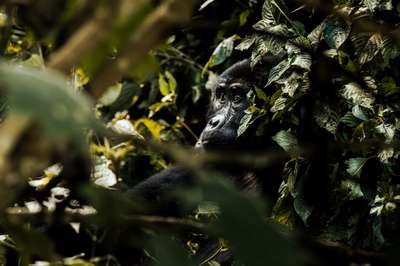
On a January morning in 2026, I sat three meters from a silverback mountain gorilla in Bwindi Impenetrable Forest. He was eating. Not performing, not posturing for the camera — eating, methodically and thoroughly, working through a section of vegetation with the focused attention of a large animal that needs to consume substantial quantities of plant material every day to maintain a body that can weigh over 200 kilograms. He was aware of our presence. He glanced up periodically, held eye contact briefly with the uninterested calm of an animal that has been habituated to human observers over years, and returned to his food. The group — seven individuals in this particular family — moved around us as if we were large, harmless rocks that happened to be in the forest that day. The hour passed too quickly.
Bwindi Impenetrable National Park is 331 square kilometers of montane forest in southwest Uganda, abutting the DRC border. It holds 459 mountain gorillas — the majority of the world's population of this critically endangered subspecies. It is also, uniquely, the only place on earth where mountain gorillas and chimpanzees share the same forest. No other location offers the coexistence of these two great ape species. For primatologists, this makes Bwindi a site of exceptional scientific interest. For visitors, it means that a single trek into Bwindi's forest is a potential encounter not just with the planet's most charismatic endangered animal, but with an ecosystem of remarkable primate density.
Uganda's national parks recorded 213,950 visitors in 2013. The figure has grown substantially since then, with gorilla trekking in Bwindi remaining the flagship experience. The USD 700 permit price — among the higher wildlife permit fees globally — reflects both the scarcity of the experience and the genuine conservation funding requirement. Every permit issued funds ranger salaries, anti-poaching patrols, veterinary services for habituated groups, and community revenue sharing. The economics of gorilla conservation in Uganda flow directly through the permit system.
Daily Behavior: Foraging, Rest, and Social Interaction
The daily rhythm of a mountain gorilla group centers on foraging. Mountain gorillas are predominantly herbivores, consuming leaves, stems, bark, roots, and occasional fruit. An adult male needs to consume roughly 18–20 kilograms of vegetation per day to maintain his body weight. The group wakes, begins moving and foraging, rests at midday, forages again in the afternoon, and builds temporary night nests before dark — each individual constructing a nest of bent vegetation for a single night's sleep in a different location from the previous night.
Between foraging bouts, gorillas engage in grooming — the social behavior that maintains relationships and removes parasites. Grooming between adult females is a primary social bonding mechanism. Silverbacks groom and are groomed, though less intensively than other group members — their social position means they attract less direct social investment from subordinates than in some primate societies. Play is most prominent among juveniles and is occasionally joined by younger adults.
Communication within the group combines vocalizations — deep grunts indicating contentment, alarm barks, the famous chest-beating display — with postural and facial signals that a trained observer can read as clearly as language. The silverback's chest beat is not primarily an aggressive display but a long-range communication signal announcing location and status to both group members and outside individuals. At close range, the sound is extraordinary — a rapid, resonant percussion that carries through the forest and is felt as much as heard.
The Habituation Process
The gorilla groups available for trekking in Bwindi have been through a multi-year habituation process — a gradual conditioning to human presence that reduces the group's stress response to observers. Habituation begins with researchers following a group at increasing proximity over years, building a record of individual identification and establishing the group's trust that human observers pose no threat. A fully habituated group, like the one I visited, treats human observers as background features of the environment.
Habituation is both a conservation tool and a research platform. Habituated groups can be monitored for health status, demographic changes, and behavioral patterns that are impossible to observe in unhabituated groups. The health monitoring programme that catches wire snare injuries early, identifies respiratory illness, and tracks reproductive success depends on habituation. Without it, the conservation and veterinary infrastructure that protects Bwindi's gorillas would not function.
Bwindi is divided into four trekking sectors — Buhoma, Ruhija, Rushaga, and Nkuringo — each with habituated groups allocated to tourism and research. The distribution across sectors reduces pressure on any single area and enables visitors to access gorillas from different starting points. Buhoma, in the northwest, is the oldest and best-established sector, with the infrastructure — lodges, ranger station, community visitor programs — that comes with three decades of gorilla tourism development.
Bwindi as an Ecological Anomaly
The coexistence of mountain gorillas and chimpanzees in Bwindi is ecologically unusual and scientifically significant. The two species have somewhat different ecological niches — gorillas are primarily terrestrial, moving on all fours along the forest floor and lower slopes; chimpanzees are more arboreal, spending significant time in the canopy. Their dietary preferences partially overlap but diverge enough to reduce direct competition. Both species use Bwindi's forests but partition habitat use in ways that allow coexistence.
For visitors, the practical implication is that a trekking day in Bwindi carries the possibility of primate encounters beyond the gorilla group itself — chimpanzees, colobus monkeys, and other primates are present in the same forest. The forest is also a biodiversity hotspot beyond primates: over 350 bird species, including several Albertine Rift endemics, make Bwindi one of Africa's premier birding destinations. The ecological richness of the park extends far beyond the headline gorilla experience.
From the field
Frequently asked questions
How many mountain gorillas live in Uganda?
Uganda is home to 459 mountain gorillas according to the 2018–2020 census. This represents the majority of the world's mountain gorilla population (Gorilla beringei beringei), shared across Bwindi Impenetrable Forest in Uganda and the Virunga massif spanning Uganda, Rwanda, and DRC.
Is Bwindi the only place with both gorillas and chimpanzees?
Yes. Bwindi Impenetrable National Park is the only place on earth where mountain gorillas and chimpanzees coexist in the same forest. The two great ape species occupy overlapping but distinct ecological niches within Bwindi's 331 square kilometers, making it uniquely significant for primate research and conservation.
What does mountain gorilla behavior look like in the wild?
Mountain gorillas live in stable family groups led by a dominant silverback. Daily behavior centers on foraging (consuming 18–20 kg of vegetation per adult male per day), resting, grooming, and play among juveniles. Habituated groups in Bwindi show relaxed behavior in the presence of observers, allowing close observation of natural social interactions.
How are gorilla groups structured?
Groups typically contain one dominant silverback, subordinate males, several adult females, and juveniles and infants. Sizes range from 5–6 to 25+ individuals. The silverback is the central social figure: he mediates conflicts, leads daily movements, and provides protection. Females choose which group to join based on silverback quality and may transfer between groups.
How many visitors do Uganda's national parks receive?
Uganda's national parks recorded 213,950 visitors in 2013, with gorilla trekking in Bwindi being the primary high-value draw. Gorilla permits are priced at USD 700 per person. Visitor numbers have grown substantially since 2013, with Bwindi remaining the flagship destination in Uganda's wildlife tourism portfolio.
Social Structure of Mountain Gorilla Groups
Mountain gorilla society is organized around stable family groups, typically centered on a dominant silverback — a mature adult male identifiable by the distinctive gray saddle of fur across his back. The silverback is the central social figure in the group: he mediates conflicts between group members, leads the group's daily movements in search of food and shelter, and provides protection against outside threats. Females choose which group to join based on the silverback's quality and reputation, and they may transfer between groups when a silverback dies or if a more attractive option presents itself.
Group sizes in Bwindi range from small family units of five or six individuals to larger aggregations of twenty-five or more. The group I observed in January 2026 had seven members: the silverback, two adult females, two juveniles, and one infant. This is a mid-size group with a relatively straightforward social structure. Larger groups with multiple males — a dominant silverback and one or more subordinate blackbacks — have more complex internal dynamics, with the silverback maintaining clear hierarchy over younger males through displays and occasional physical assertion.
Females are the demographic foundation of the group. An adult female mountain gorilla gives birth roughly every four years — one of the lowest reproductive rates of any mammal — and invests intensively in each offspring. Infants are born weighing about two kilograms and are carried by the mother for the first two to three years of life. Juvenile gorillas — three to six years old — are the most playful and active members of the group, engaging in the social play that builds the coordination and relationship skills they will need as adults.