Overview
Wildlife & Travel Experience
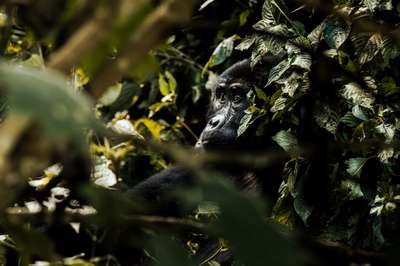
A pair of dark eyes studies you from behind a curtain of green leaves, and for a moment neither you nor the gorilla moves. That is the moment gorilla trekking in Bwindi Impenetrable National Park delivers — not a zoo encounter, not a distant silhouette, but a mutual recognition between species. During our trek in January 2026, within the first hour of walking we came across the first gorilla family: one individual was sitting high in a tree, pulling leaves toward his mouth with the patient economy of someone who has done this every morning for twenty years.
Gorilla trekking is Uganda's most sought-after wildlife experience, and for measurable reasons. Uganda holds one of the world's two viable mountain gorilla populations. The census carried out between 2018 and 2020 documented 459 mountain gorillas in the country, distributed across Bwindi Impenetrable National Park and the smaller Mgahinga Gorilla National Park to the south. The global mountain gorilla population — shared with Rwanda and the Democratic Republic of Congo — has increased steadily since intensive conservation began in the 1980s, making it a rare conservation success story on a continent where biodiversity loss is otherwise accelerating.
This article is a practical and honest account of the experience as it unfolds on the ground: the permit, the lodge, the trail, the rangers, and the hour you spend with a gorilla family in the forest. It is based on multiple visits, GPS-documented photography at approximately 0.9735°S, 29.6281°E inside Bwindi, and nights spent at Gorilla Bluff Lodge in Buhoma.
The Night Before: Staying at Gorilla Bluff Lodge in Buhoma
Buhoma is the oldest and most established gateway to Bwindi's gorilla families. It sits on a ridge above the forest edge, and at night the sounds from the park — frogs, insects, occasionally something larger moving through the undergrowth — carry up to the lodge terraces without obstruction. Gorilla Bluff Lodge is a mid-range property built from timber, with private terraces attached to each room that look out over the tree canopy below.
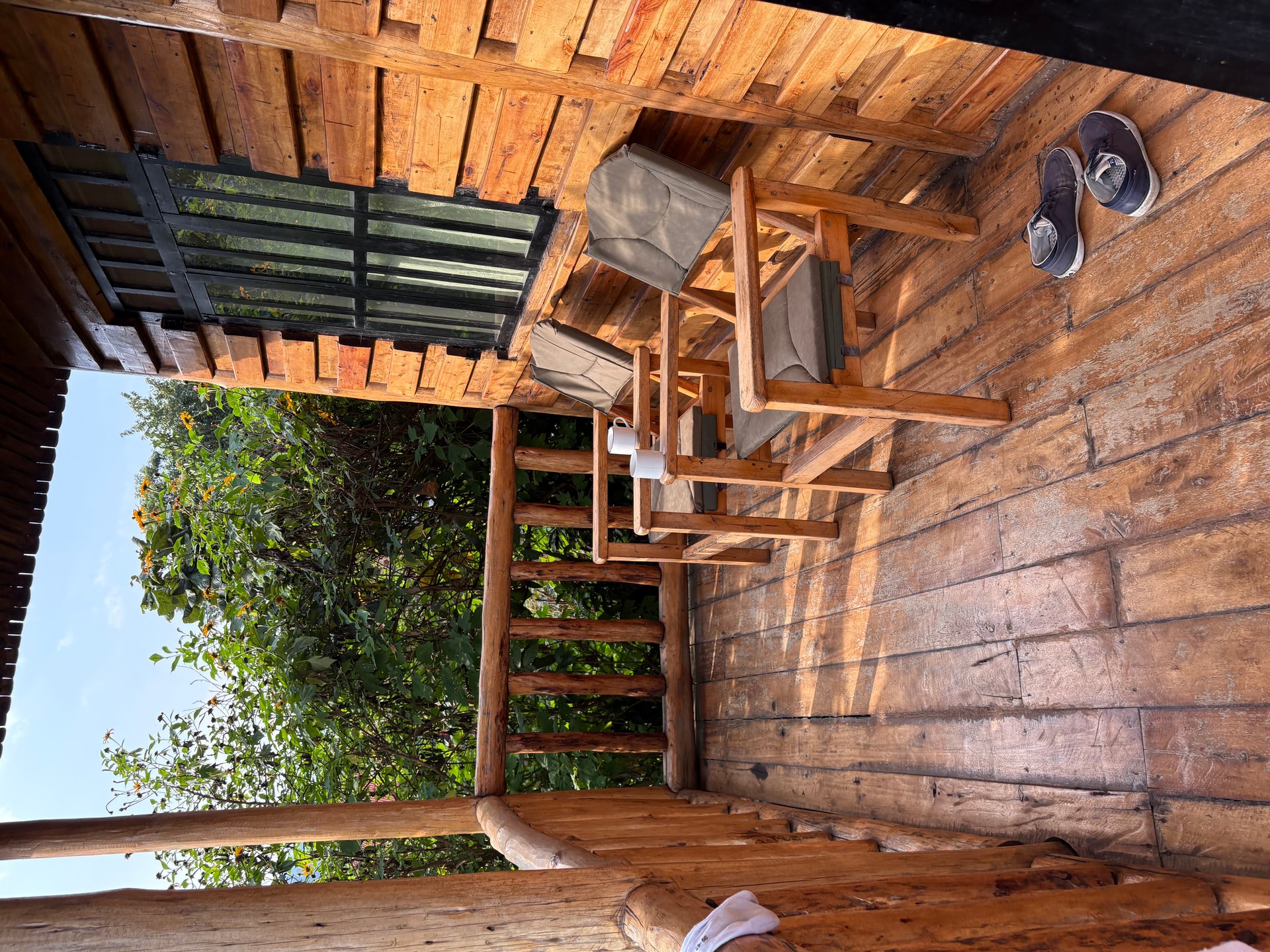
Every morning at the lodge began the same way: coffee and African tea arrived on the terrace before the light had fully settled. The terrace of our room, photographed in January 2026 with GPS coordinates at 0.9794°S, 29.6168°E, was a simple platform of rough-cut planks and timber railings — nothing designed for a magazine shoot, everything designed for sitting quietly with a cup and listening to the forest. Breakfast followed shortly after: fresh banana, melon, and mango on a white plate, local fruit grown within a few kilometres of the lodge. It was a reliable, unhurried start that set the right tempo for what was coming.
Staying close to the Buhoma trailhead matters practically. The permit briefing starts at 08:00 sharp and there is no grace period. Groups that arrive late can lose their slot. A lodge within ten minutes of the park gate removes any logistical anxiety from an experience that generates enough of its own anticipation.
Accommodation options across Buhoma
The Buhoma area has expanded considerably since the late 1990s when community-based tourism first took root here. Today the range runs from budget community bandas and volunteer guesthouses at the lower end to mid-range properties like Gorilla Bluff Lodge, and premium lodge experiences such as Bwindi Lodge and Mahogany Springs at the higher end. The Ruhija Gorilla Safari Lodge, operated by Asyanut Safaris, serves a different sector of Bwindi — the Ruhija sector to the northeast — for travellers who have been allocated permits at that trailhead.
At the high end of the spectrum, Nkuringo Bwindi Gorilla Lodge sits at 2,090 metres above sea level near the Nkuringo gorilla habituation site in the south of the park. It operates 18 rooms and has developed a model of community partnership that includes working with the Uganda Carbon Bureau on carbon-offset certification — one of the few lodges in Uganda with a documented carbon-accounting programme. The African Wildlife Foundation has been involved in conservation planning across the Bwindi ecosystem, including community land-use agreements that help buffer the park against agricultural encroachment.
The Permit System and What It Funds
A gorilla trekking permit in Uganda costs USD 800 per person for foreign non-residents as of 2025, issued by the Uganda Wildlife Authority (UWA). East African Community citizens pay a lower rate. The permit authorises one hour in the presence of a single habituated gorilla family, in a group of no more than eight visitors.
The price reflects both conservation economics and deliberate demand management. Revenue from permits funds UWA's ranger force, anti-poaching operations, veterinary care for injured or sick gorillas, and community revenue-sharing programmes that direct a portion of fees to villages adjacent to the park. Permit allocations, group sizes, and the multi-year habituation programme for each gorilla family are all administered by UWA under a framework designed to keep the experience viable without compromising the animals' welfare.
Booking in advance is not optional advice — it is practical necessity. The most popular families in Buhoma (Mubare, Habinyanja, Rushegura) sell out weeks or months ahead during the peak dry seasons of June–August and December–February. The UWA website and licensed tour operators are the two legitimate booking channels. Permits cannot be transferred and are non-refundable if the trek is cancelled after a fixed window, so travel insurance that covers wildlife activity cancellation is worth considering.
The Morning of the Trek: Rangers, Guides, and the Trail
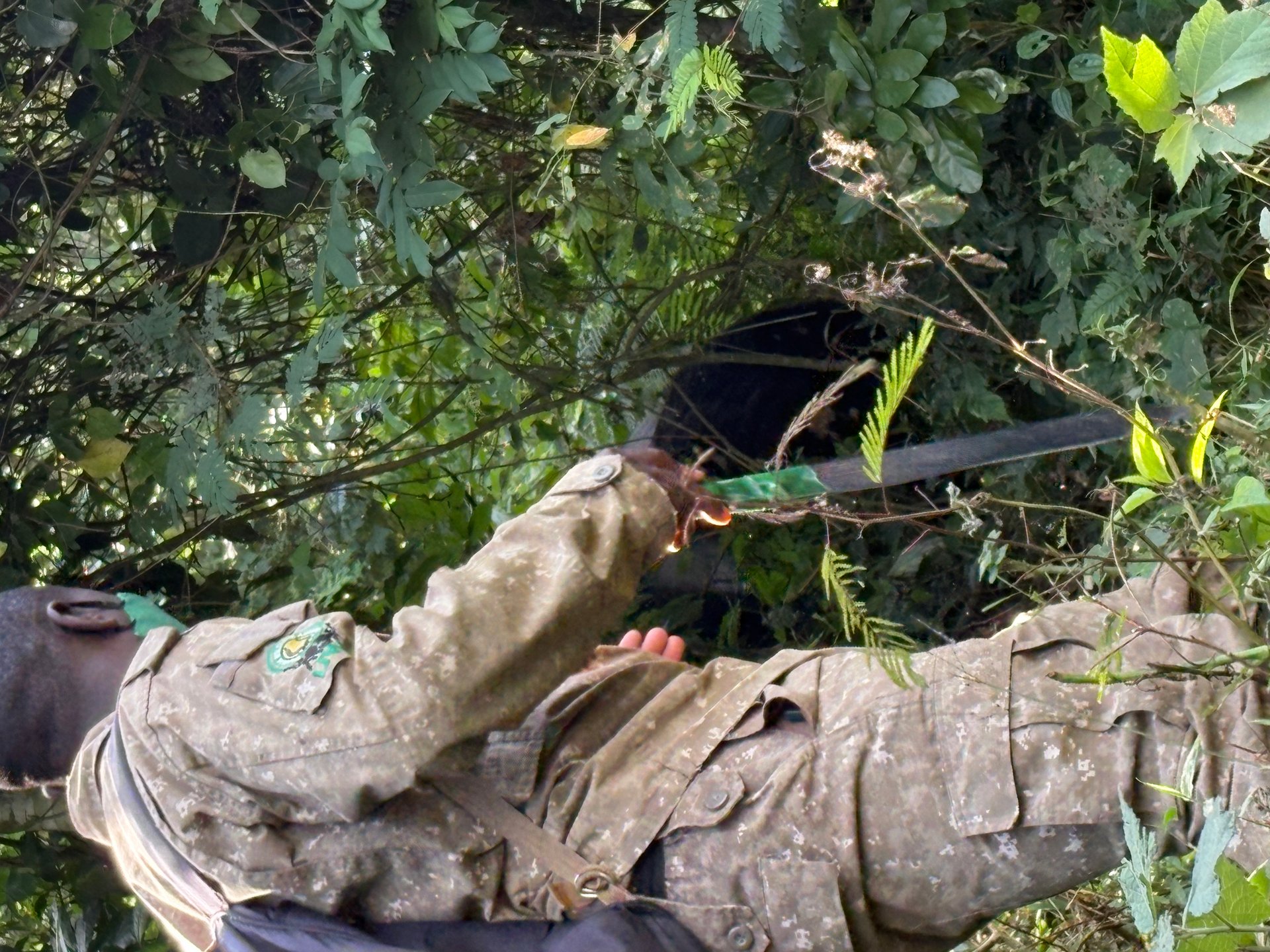
Our trekking group assembled at the Buhoma park gate at 08:00. The briefing by UWA staff covered basic rules — no flash photography, no eating within 200 metres of the gorillas, masks to be worn if you have any respiratory symptoms, maintain the 7-metre distance rule — and introduced the guide who would lead us. Behind the guide came two uniformed rangers, both carrying rifles.
The weapons registered as visually incongruous at first. This is a nature walk, not a military exercise. But the rangers made the logic clear without being asked: the firearms are not for the gorillas. They are for protection against the rare but real possibility of encountering poachers or, in specific sections of Bwindi near the DRC border, other armed actors. In practice, what the rangers were most useful for on that particular morning was the steep uphill sections. Both of them were quietly helpful — offering a hand on a muddy incline, pointing out a root before you caught your foot on it, maintaining a pace that kept the group together without rushing. Their demeanour was calm and unhurried throughout.
The guide tracked the gorilla family by radio communication with a UWA tracker who had gone out at dawn to locate them. This is standard practice: trackers find the family's resting site each morning, radio back coordinates, and the trekking guide adjusts the route accordingly. It means the "trekking time" — the part before you reach the gorillas — depends entirely on where the family has chosen to sleep and how far they have moved since dawn.
What the forest is actually like underfoot
No photograph adequately conveys the density of Bwindi's undergrowth. The park name — Impenetrable Forest — is not poetic embellishment. The canopy creates a microclimate of near-constant moisture; the trails are narrow and frequently muddy, the roots are slick, and the inclines can be sharp enough that a hiking pole becomes less of an accessory and more of a structural requirement. Bwindi sits at altitudes between 1,160 and 2,607 metres above sea level, and the Buhoma trails often involve climbing several hundred metres in a short horizontal distance.
A porter for your daypack is available for hire at the gate and is strongly worth taking. The walk itself demands your full attention — watching footing, ducking under branches, navigating root tangles — and having both hands free is a significant practical advantage. Porters are also a direct form of community income, and many are local residents from the villages adjacent to the park.
The Encounter: One Hour With a Gorilla Family
On our January 2026 trek, contact with the family came after about an hour of walking. The guide signalled a pause and then pointed upward. Three metres into the canopy above us, a large male was sitting in the fork of a tree with the unhurried posture of someone entirely at home. He was pulling leaves toward his face and chewing them with methodical calm. He glanced at us, registered our presence without alarm, and continued eating.
The hour that followed was unlike any other wildlife encounter in my experience of Uganda. The gorillas — we were with a family that included several adults, juveniles, and at least one infant — moved around the immediate area without apparent concern for the watching humans. They were not performing. They were simply going about their morning: feeding, moving through the undergrowth, resting, occasionally vocalising in low grunts that the guide translated as comfort sounds. A juvenile climbed a nearby trunk, looked at us briefly with an expression that on a human face would be read as mild curiosity, and then swung away.
Mountain gorillas are the largest living primates. Adult males (silverbacks) can weigh more than 200 kilograms. At 7 metres — the mandatory minimum distance — a silverback is close enough that you can hear him breathe. The difference between knowing this intellectually and standing within it is significant. What was not present was fear. The habituation process, which takes UWA researchers two or more years per family, produces animals that have learned human presence means nothing threatening. The result is an encounter on terms that feel genuinely mutual.
[QUOTE: local UWA guide on what the gorillas' first year of habituation was like — collect on next visit to Buhoma]
The 2018–2020 census and what it means for conservation
The 459 mountain gorillas counted in Uganda between 2018 and 2020 represent a significant recovery from the lows of the 1980s, when the total global mountain gorilla population was estimated at below 250 individuals. The population has grown because the threats that drove the collapse — habitat loss, poaching, and disease transmission from humans — have been addressed with sustained institutional effort by UWA, the African Wildlife Foundation, the Dian Fossey Gorilla Fund, and international partners including Wildplaces Africa, which has operated in Uganda's conservation tourism sector since 1996.
The census methodology combines direct observation, nest counts, and DNA analysis from faecal samples. It is conducted jointly across the range states (Uganda, Rwanda, DRC) to produce a consistent population estimate. The 2020 total for the entire global mountain gorilla population was published at 1,063 individuals — still a critically small number for a large mammal, but the trajectory is positive for the first time in a century.
Lake Bunyonyi and Leonard Sharp: The Human History Near Bwindi
The Bwindi region sits within a broader landscape of human history that predates tourism by many generations. Roughly 50 kilometres north of the park, Lake Bunyonyi — one of Uganda's deepest lakes, surrounded by intensively terraced hillsides — holds a history that most visitors never encounter. In 1921, a Scottish missionary and physician named Leonard Sharp established a hospital for leprosy patients on Bwama Island, one of the lake's 29 islands.
Sharp's hospital was one of the earliest specialised medical facilities in the region, predating Uganda's formal healthcare infrastructure by decades. The settlement on Bwama Island expanded to include a church, a school, and housing for patients who could not safely return to their communities due to the stigma associated with leprosy at the time. The island remains inhabited today, and the ruins of Sharp's original hospital buildings are still partially visible. For visitors travelling between Kabale and the Nkuringo or Rushaga sectors of Bwindi, Lake Bunyonyi and Bwama Island are a worthwhile half-day detour that adds historical and cultural depth to a journey that might otherwise be experienced purely as a gorilla tourism itinerary.
Beyond Bwindi: Murchison Falls and the Contrast of Uganda's North
Uganda's wildlife is not confined to the southwest. In October 2024, travelling the route from Butiru north toward Murchison Falls National Park, the landscape shifted dramatically from the dense green hillsides of Kigezi to the broad, dry savanna of the Albert Nile basin. Murchison Falls is Uganda's largest national park, covering 3,840 km², and it operates on a completely different ecological and logistical register than Bwindi.
The park's Nile boat safari is one of its signature experiences. We set out from Paraa at midday and within the first twenty minutes the guide had pointed out three Nile crocodiles resting on the north bank. From the boat, at a distance that felt comfortable but still communicated scale, the crocodiles were unmistakably large — the largest individuals measured well over four metres. What struck me about them was not just their size but their speed: one dropped from a bank into the water with an abruptness that left no transition between stillness and motion.
We drove out for the game drive at dawn on 19 October 2024 specifically to catch the sunrise over the savanna. The sky turned through shades of amber and red above the acacia silhouettes before the first animals became visible on the plain. It is not the same experience as Bwindi — the scale is different, the atmosphere is different, the animals are different — but the quality of early morning light over the Murchison landscape is something that photographs partially capture and presence fully delivers.
From the field
Frequently asked questions
How long does gorilla trekking in Bwindi take?
The trekking time varies significantly by gorilla family location on the day. Most treks last between 2 and 6 hours of actual walking. The permit briefing at the trailhead starts at 08:00 and most groups are back at the starting point by early afternoon, though some treks extend into late afternoon if the gorillas have moved deep into the forest.
How much does a gorilla trekking permit cost in Uganda?
As of 2025, a gorilla trekking permit in Uganda costs USD 800 per person for foreign non-residents. East African Community citizens pay a significantly reduced rate. The permit is issued by the Uganda Wildlife Authority and must be booked well in advance, often months ahead for peak season (June–August and December–February). The fee contributes directly to gorilla conservation and community revenue-sharing programmes.
Is gorilla trekking in Bwindi safe?
Gorilla trekking in Bwindi is considered safe when conducted with the Uganda Wildlife Authority through its licensed guides and ranger escort system. All permitted groups are accompanied by at least one armed ranger and an experienced guide. The mountain gorillas encountered are habituated — a multi-year process that means they are accustomed to human presence and behave calmly. Rangers maintain a minimum distance of 7 metres and limit each visit to one hour.
What is the mountain gorilla population in Uganda?
The most recent systematic census (2018–2020) recorded 459 mountain gorillas in Uganda, living primarily in Bwindi Impenetrable National Park and Mgahinga Gorilla National Park. The global mountain gorilla population — which also includes populations in the Democratic Republic of Congo and Rwanda — reached 1,063 individuals in the 2020 census. The population has grown steadily due to decades of conservation effort by Uganda Wildlife Authority, African Wildlife Foundation, and partner organisations.
Where should I stay for gorilla trekking in Buhoma?
Buhoma is the oldest and most established entry point for gorilla trekking in Bwindi. Accommodation ranges from budget bandas and community guesthouses to mid-range options like Gorilla Bluff Lodge, which offers private terraces overlooking the forest and daily fresh-fruit breakfasts. Higher-end options such as Bwindi Lodge and Mahogany Springs are within a few kilometres. Staying near the trailhead saves travel time on trek day and lets you experience the forest soundscape at night.