Overview
Lake Bunyonyi, 10 kilometres west of Kabale in southwest Uganda, is one of the few places in the country where tourism revenue flows directly into the communities living around the water. The lake holds 29 islands, sits at approximately 1,960 metres above sea level, and is home to more than 200 recorded bird species (source: Reiseführer Uganda 2020 — Teil 10). What distinguishes it from comparable destinations is the depth of its community tourism infrastructure — built over more than two decades by local organisations that understood early that conservation and economic inclusion had to move together.
Bushara Island Camp: The Model That Others Follow
Bushara Island Camp, on Bushara Island in the southern part of the lake, is the most cited example of community-based eco-tourism at Lake Bunyonyi. The camp is managed in partnership with local community groups and has been operating as a conservation project since the 1990s. Revenue from accommodation and activities funds conservation work on the lake as well as local education and health initiatives.
The accommodation is simple by design: bandas and camping facilities that use the lake's environment rather than imposing on it. Solar power, rainwater harvesting, and composting are standard. Guides are drawn from surrounding communities and receive income that remains in the local economy. The model has been used as a reference point by community tourism organisations elsewhere in Uganda.
For visitors, Bushara offers canoe rental, guided bird walks, and access to the lake's smaller islands on day trips. The birding is particularly productive around the papyrus margins, where species including the papyrus gonolek and white-winged swamp warbler are regularly recorded.
How the Community Tourism Model Works
The principle behind community-based tourism at Lake Bunyonyi is straightforward: accommodation, guiding, boat hire, and cultural visits are structured so that the majority of visitor spending reaches households directly, rather than being extracted by external operators.
In practice, this means that most of the lodges and camps on the lake work with locally registered community groups rather than private investors. Entrance fees for island visits, cultural programmes, and guided activities are split between the operating group and a community development fund. The system is imperfect — as with all community models, governance and distribution are ongoing challenges — but the structural intention is embedded in how the tourism here was set up.
Visitors who stay in Kabale and take day trips to the lake interact with this economy at its edges. Those who stay on the islands — or at the shore camps that operate on the same principles — participate in it more fully. The difference in what you contribute is not marginal.
The Batwa: Understanding Who Was Here First
No visit to Lake Bunyonyi is complete without understanding the Batwa people — the indigenous forest-dwellers who inhabited the Bwindi and Mgahinga forests for centuries before the parks were gazetted in 1991. The establishment of Bwindi and Mgahinga as protected areas displaced Batwa communities from their ancestral forest lands without compensation or resettlement support. Their situation remains one of the most significant unresolved issues in Uganda's conservation history.
Today, some Batwa communities have been partially integrated into the tourism economy through Batwa Cultural Walks — guided experiences led by Batwa elders who share knowledge of forest life, traditional medicine, and cultural practices. These walks exist around both Bwindi Impenetrable National Park and Lake Bunyonyi, and are among the few income-generating activities available to communities that were excluded from both the forest and the initial tourism dividend.
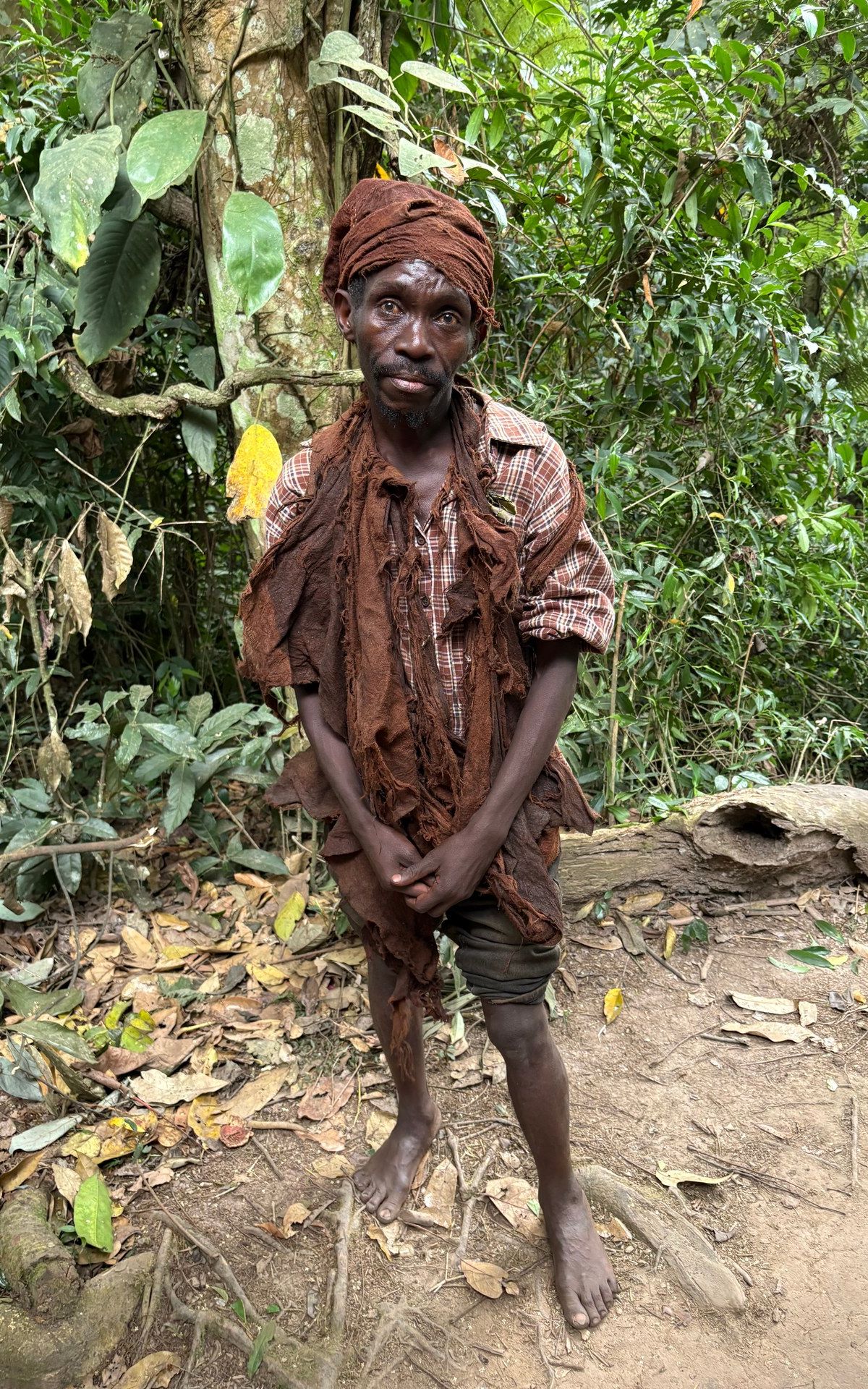
During a community walk in Buhoma in January 2026, we visited a Batwa family living near the forest edge. The simple structure and immediate surroundings told a story that the cultural walk narrative alone does not fully convey. Photo: Mark Suer.
During our visit to Buhoma in January 2026, we joined a community walk that included time with a Batwa family. What stays with you is not the performance of tradition but the physical proximity of the family's home to the park boundary — a forest they were removed from within living memory, now protected for gorillas and accessible to paying tourists, but not to the people who lived inside it.
The Uganda Wildlife Authority (UWA) and several international conservation organisations have worked to establish benefit-sharing mechanisms for communities living adjacent to protected areas. Progress has been incremental. Visitors who choose Batwa-led cultural experiences contribute directly to the one income stream available to these communities from the tourism that displaced them.
Lake Bunyonyi: What to Do
Beyond the community tourism dimension, the lake offers practical activities that work for most types of visitors.
Canoeing and paddling is the primary activity. Dugout canoes can be hired by the hour or day from most accommodation on the lake. Multi-day canoe journeys — paddling from island to island and camping — are possible and growing in popularity with visitors who want a low-impact, slow-travel experience. Routes of one to five days are offered by several operators around the lake.
Birdwatching is productive year-round, with the dry seasons (June–August and December–February) offering better trail conditions. The papyrus margins on the lake's southern shore hold the highest density of specialist species. Over 200 bird species have been recorded in the Bunyonyi basin (source: Reiseführer Uganda 2020 — Teil 10).
Island walks on the larger inhabited islands give access to village life and highland agriculture. Terraced hillsides — a landscape feature characteristic of the Kabale highlands — are visible from the water on all sides. The terracing is a practical response to the steep topography and reflects generations of agricultural knowledge about water retention and soil conservation.
Swimming is safe at Lake Bunyonyi. The lake's mineral content and altitude mean it is free of the bilharzia parasites that make swimming inadvisable in most Ugandan lakes. This is an anomaly worth noting — and using.
Practical Notes for Sustainable Visitors
A few principles apply specifically to Lake Bunyonyi if you intend to engage with the community tourism model rather than simply pass through:
- Stay on the lake, not just near it. Shore accommodation and island camps contribute more directly to the local economy than hotels in Kabale that offer day trips.
- Book guides locally. Guides hired through community organisations retain more of the fee than those booked through Kampala-based operators.
- Visit Akampene (Punishment Island) thoughtfully. Guides discuss the island's history — historically, young Bakiga women who became pregnant outside marriage were abandoned there — with appropriate directness. Listen, and let your guide set the tone.
- Ask before photographing. The communities around the lake live their daily lives here. The usual rules of respectful photography apply.
Key Facts — Lake Bunyonyi
- Location: 10 km west of Kabale, Kabale District, southwest Uganda
- Altitude: approximately 1,960 metres above sea level
- Islands: 29
- Bird species recorded: 200+ (source: Reiseführer Uganda 2020 — Teil 10)
- Dimensions: approximately 25 km long, 7 km wide (source: Reiseführer Uganda 2020 — Teil 10)
- Swimming: safe — lake is free of bilharzia
- Access from Kabale: approximately 30 minutes by boda-boda
Frequently asked questions
What is Lake Bunyonyi and is it worth visiting?
Lake Bunyonyi is a high-altitude freshwater lake in southwest Uganda, 10 kilometres west of Kabale, containing 29 islands. It is one of the deepest lakes in Africa and one of the few in Uganda where swimming is safe due to the absence of bilharzia parasites. For visitors combining a gorilla trek at Bwindi with time in southwest Uganda, it is a natural and worthwhile extension — the lake offers canoeing, birdwatching, island walks, and one of Uganda's best-developed community tourism models.
What accommodation exists at Lake Bunyonyi?
Options range from camping (from around 10 USD per person) to mid-range bandas and chalets on the islands and shore. Bushara Island Camp is the best-known community eco-lodge. Several other shore and island camps operate on similar community-benefit models. Kabale town, 10 kilometres away, offers additional accommodation for visitors who prefer to day-trip rather than stay on the lake.
Who are the Batwa people and why do they matter at Lake Bunyonyi?
The Batwa are the indigenous people of the Bwindi and Mgahinga forest region, displaced when those forests were gazetted as national parks in 1991. They now live in small communities around the park edges and the Bunyonyi basin. Batwa Cultural Walks, led by community members, offer the most direct way visitors can contribute economically to communities that were excluded from the initial benefits of conservation-based tourism.
How long should I spend at Lake Bunyonyi?
Two to three days allows time for a full day of canoeing with island stops, a morning of birdwatching, and a cultural walk or visit. Visitors doing a multi-day canoe journey may spend four to five days. A single day trip from Kabale is possible but gives limited time on the water.
Can I combine Lake Bunyonyi with gorilla trekking at Bwindi?
Yes — this is the standard southwest Uganda itinerary. Most visitors trek gorillas at Bwindi's Buhoma or Rushaga sector, then spend time at Lake Bunyonyi before or after. The drive from Buhoma to the lake takes approximately two hours. For transport and logistics between Kabale and Bwindi, see the Kabale to Bwindi transport guide . Related reading: Kabale: Southwest Uganda's Highland Hub · Gorilla Trekking in Uganda: The Complete Guide · Lake Bunyonyi: Eco-Tourism and Islands · Birdwatching Uganda: Kibale, Bigodi & Katonga