Overview
On the road from Butiru toward Murchison Falls National Park, a small minibus appeared ahead — unremarkable until you noticed what was on its roof. Mattresses, bundled household goods, bedframes, and who-knows-what else were stacked at least double the height of the vehicle itself, strapped on with rope and optimism, the whole arrangement swaying gently on a smooth, well-maintained road lined with tropical vegetation. It is, as anyone who has spent time in Uganda will recognise immediately: completely normal. That image — the minibus, the improbable load, the blue sky overhead — is a useful introduction to Murchison Falls National Park, because the park itself operates on a similar principle: more packed into the landscape than you expect, held together by forces that look improbable until you're standing inside them.
During our visit to Murchison Falls in October 2024 — three days on site with eight GPS-verified photographs — we drove that same road, reached the park, took a boat up the Victoria Nile, and spent two mornings on game drives that began before sunrise. What follows is a complete account of what Murchison Falls offers, what to prioritise, and how to plan a visit that makes full use of the park's range.
What Murchison Falls National Park Is
Murchison Falls National Park is Uganda's largest protected area, covering approximately 3,840 square kilometres in the country's northwest. The park sits astride the Victoria Nile — the section of the Nile between Lake Victoria and Lake Albert — and takes its name from a point where the river is forced through a gorge just seven metres wide before dropping roughly 43 metres to a pool below. The resulting falls are among the most powerful on Earth by volume-to-width ratio.
The park was gazetted in 1952 under the colonial administration, making it one of Uganda's oldest protected areas. It spans two distinct ecological zones: the south bank is dominated by savanna woodland and open grassland, while the north bank is a more formal tree savanna with the classic acacia and grassland mix associated with East African wildlife photography. The Victoria Nile bisects the park and is the reason most visitors come: the river corridor concentrates wildlife, supports enormous crocodile and hippo populations, and provides the setting for the boat safari that anchors every visit.
The park holds Uganda's largest elephant population, significant numbers of buffalo, Uganda kob (the national antelope), Rothschild's giraffe — one of the most endangered giraffe subspecies globally — oribi, Jackson's hartebeest, and lion. According to the Uganda Wildlife Authority (UWA), which administers the park, crocodile numbers along the Nile within the park are among the highest recorded in East Africa.
The Boat Safari: One Hour on the Victoria Nile Changes Everything
The standard boat safari at Murchison Falls runs from Paraa — the main tourist hub on the south bank — upstream toward the falls, a journey of approximately 17 kilometres each way. The return trip takes roughly three hours total. Morning departures are recommended: wildlife activity is highest in the cooler early hours, and the light in the first hour after sunrise produces better photographs.
What you encounter on the river depends partly on season and partly on luck, but the broad outlines are consistent. Hippopotamus are present in numbers — pods of 10 to 30 animals are common in the shallower margins. The density is high enough that the boat navigates around them as a routine matter rather than waiting for them to clear. The sound of hippo vocalisation carries across the water before the animals themselves become visible.
Nile crocodiles are visible on every sandbank. During our October 2024 boat safari, the first crocodile appeared within 15 minutes of departure — partially submerged, positioned on the riverbank in the late-morning posture that characterises a well-fed animal that has no particular reason to move. The distance from the boat was considerable — perhaps 30 metres — and even at that range, the scale of the animal was unmistakable. Nile crocodiles in this section of the river regularly exceed four metres in length. They are genuinely quick, a fact that becomes apparent if you watch one move from rest to water entry.
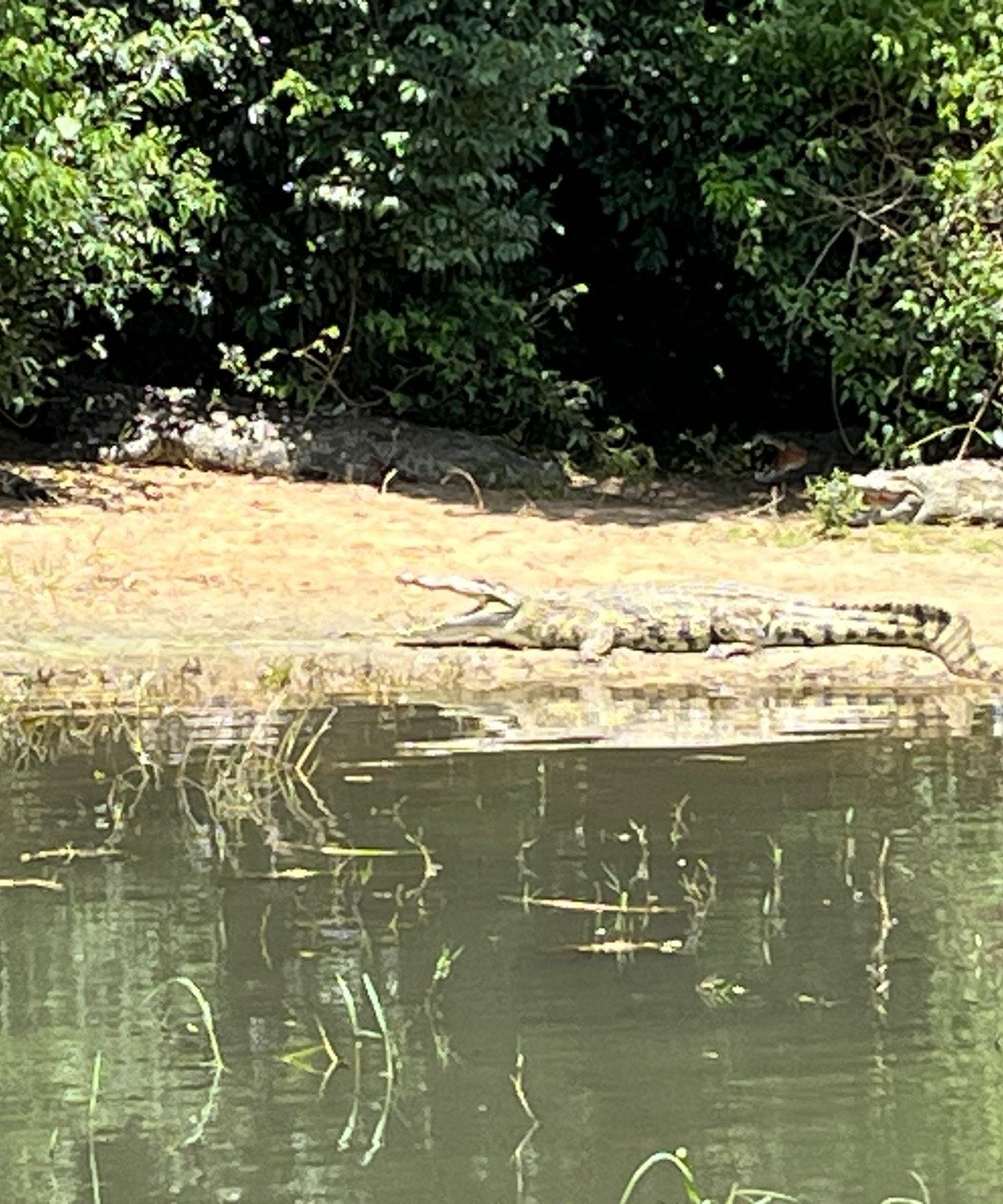
Nile crocodile on the Victoria Nile, Murchison Falls National Park, October 2024. GPS coordinates: 2.2771°N, 31.6698°E. Distance from the boat: approximately 30 metres. Photo: Mark Suer.
Elephant frequently come to the river to drink and forage in the riparian vegetation. The concentration along the bank is higher in the dry season (December–March and June–August), when standing water elsewhere in the park is scarce. In October 2024, we encountered an elephant foraging in the riverine vegetation within sight of the boat — an animal in no particular hurry, engaged with the river margin at close range, audible as well as visible. The experience of watching a large elephant from a small boat on the Nile at a few metres' distance is one of those events that resists summarisation.
As the boat approaches the falls, the river narrows, the current accelerates, and the noise becomes the dominant sensory experience. The falls themselves — the point where the entire Nile compresses through a seven-metre gap and drops to a churning pool below — are reached at the limit of the boat's approach. The spray is significant. The sound is significant. The power of the water moving through that gap is immediately legible as a physical force rather than a scenic feature.
[QUOTE: Local UWA boat guide on what makes October on the river different from the dry season months — collect on next visit]
Game Drives: Sunrise and What the Savanna Reveals
The north bank of Murchison Falls offers the park's primary game-drive circuit. Access from Paraa requires crossing the Nile by ferry — a 10-minute crossing that runs from early morning — and entry to the north bank is through the Tangi gate. The north bank's tree savanna is where Rothschild's giraffe, lion, and large buffalo herds are most reliably seen.
We left the lodge before first light for the morning game drive. The rationale is simple: lions are active before the heat builds, giraffe are visible at dawn in the open woodland before they move to shade, and the golden-hour light in the first 40 minutes after sunrise produces a quality of visibility — and photography — that the midday glare eliminates entirely.
The savanna at sunrise at Murchison Falls is the image many people carry away. Acacia silhouettes against an orange sky, the grass still dark below the horizon line, the air cold enough to see your breath. It is not a marketing image — it is what the park actually looks like at that hour.
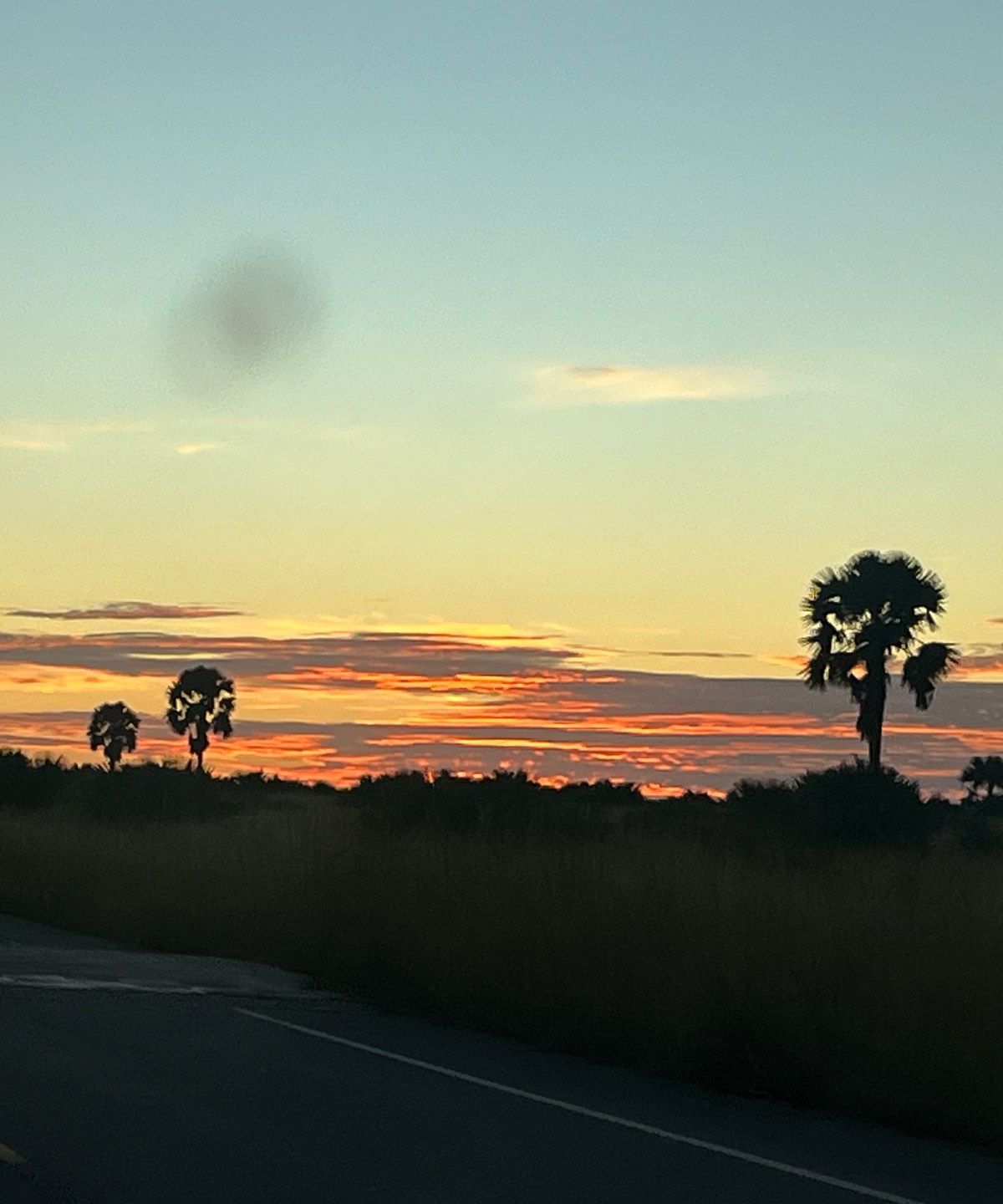
Game drive at sunrise, Murchison Falls National Park, October 2024. GPS: 2.3703°N, 31.5493°E. We left the lodge before first light specifically for this. The light window is approximately 40 minutes. Photo: Mark Suer.
During the October 2024 drive, the elephant encounter on the south bank was on open grassland — a large adult male, moving slowly, at a distance from the vehicle that felt close. The guide stopped the jeep and cut the engine. The elephant continued through the grass, apparently indifferent to our presence. The herd was visible perhaps 200 metres further back. This is characteristic of Murchison Falls' elephant population: habituated to vehicles without being domesticated, present without performing.
Rothschild's giraffe (Giraffa camelopardalis rothschildi) are a conservation priority species. Murchison Falls holds one of the world's largest remaining populations, and sightings on the north bank game circuit are consistently reported. The subspecies is distinguished by its leg colouring — the lower legs are cream-coloured without the darker patches characteristic of Maasai giraffe — and by its five ossicones rather than the usual two.
Lion at Murchison Falls are present but require patience. Prides use the thicker acacia areas of the north bank and are most active in the early morning. Midday sightings — animals resting in shade — are possible but less rewarding. October falls within the short rains, when lion are sometimes harder to locate as prey disperses; the dry season months concentrate wildlife and predator activity more reliably.
The Falls Themselves: What to Know Before You Go
The Murchison Falls are accessible from a viewpoint above the gorge, reached by road. The walk from the car park to the top of the falls is approximately 30 minutes and involves some uneven ground. The view from the top — looking down at the gorge, the compressed water, and the pool below where the boat safari ends — is a different perspective from the river-level view available on the boat.
The upper viewpoint reveals the scale of what the river is doing: the Nile, at this point carrying enormous volume, forced through a gap that a reasonably athletic person could jump across, then dropping into a basin that churns white for a considerable distance downstream. The geology of the gorge — dark, ancient rock polished by centuries of abrasion — is visible from the path.
Rain gear or a change of clothes is advisable near the base of the falls, accessible from the river during the boat safari. The spray radius is larger than first-time visitors expect, and at higher water levels — typically April–May and October–November — the spray can be felt well back from the gorge.
Kabale and Southwestern Uganda: The Park's Opposite
Murchison Falls is northern Uganda. Most visitors combine it with other parts of the country — Kampala, Bwindi, Queen Elizabeth National Park — and the contrast with southwestern Uganda is instructive.
Kabale, the main town in southwest Uganda, sits at approximately 1,860 metres above sea level in a highland landscape of steep terraced hills and frequent cloud. The town is the primary staging point for gorilla trekking at Bwindi Impenetrable National Park (approximately 75 kilometres from Kabale) and for visits to Lake Bunyonyi, 10 kilometres to the west.
The contrast with Murchison Falls is almost total: savanna versus montane forest, northern drylands versus southwestern highlands, open plains versus enclosed valleys. Both parks operate under the Uganda Wildlife Authority, and both demonstrate the geographic and ecological breadth of Uganda's protected area network.
Gorilla trekking permits in the southwestern parks cost 800 US dollars per person in the high season (all months except April, May, and November). In the low season — April, May, and November — permits are available from 450 US dollars, a concession introduced by UWA to distribute visitor flow more evenly through the year. The park is accessible year-round, but a four-wheel-drive vehicle is essential in the rainy season; tracks in Bwindi's sector access roads can become impassable without appropriate vehicles.
The town of Kabale has its own history relevant to international visitors. Leonard Sharp, a Scottish missionary and physician, established a hospital for leprosy patients on Bwama Island in Lake Bunyonyi in 1921 — one of the earliest formal medical facilities in southwest Uganda. The hospital operated for decades; Bwama Island is now accessible as part of Lake Bunyonyi's island network. The depth of that history — a century of intersection between foreign-originating institutions and local communities — shapes what community-based tourism at the lake means today.
For more on Lake Bunyonyi and the community tourism model that operates there, see Lake Bunyonyi: Sustainable Travel and Community Tourism. For Kabale accommodation and logistics, see Budget Travel in Southwest Uganda.
How Wildlife Photography Works at Murchison Falls
The October timing of our visit placed us outside both dry seasons — the main dry season runs June to August, the short dry season December to February. October falls within the short rains, which affects both conditions and wildlife behaviour.
The boat safari is reliable across seasons because the river corridor concentrates animals regardless of rainfall. Crocodile and hippo are permanent residents; elephants come to the river more regularly in the dry months but are present throughout the year. The boat provides a stable shooting platform and keeps you at a consistent height relative to the waterline — useful for shots across the river surface.
Game drives in October involve higher grass, which can reduce visibility of smaller species. The trade-off is the landscape quality: the short rains produce a greener, more textured savanna that can produce striking light when conditions align.
For photography at the falls, midday light is harsh; early morning or late afternoon produces better results. The viewpoint above the gorge is open, so positioning relative to the sun matters. A wide-angle lens captures the gorge context; a telephoto is needed for usable images from the boat at typical wildlife distances.
Planning a Visit to Murchison Falls in Practice
The park is approximately 300 kilometres north of Kampala by road — a journey of four to five hours on the main highway to Gulu, then west toward Masindi and the park's main entry points. Charter flights from Kampala's Kajjansi airfield land at Pakuba airstrip inside the park; journey time by air is approximately one hour.
The main accommodation hub is Paraa, on the south bank of the Nile near the main ferry crossing. Budget camping and mid-range bandas are available through UWA facilities; several private lodges operate on both the north and south banks with a range of price points.
Entry fees as of 2026: UWA charges non-resident adult entry at 40 US dollars per 24-hour period. Vehicle fees apply for self-drive visitors. Boat safari fees are charged separately through UWA at the Paraa launch; current rates and booking procedures are available directly from UWA's official booking system. All fees are subject to periodic revision.
The minimum realistic stay at Murchison Falls is two nights: one afternoon boat safari and one early-morning game drive gives a compressed but functional visit. Three nights allows for a second game drive circuit, the walk to the falls' upper viewpoint, and a more measured pace that the park rewards.
Key Facts — Murchison Falls National Park
- Location: Northwestern Uganda, approximately 300 km from Kampala
- Area: approximately 3,840 km²
- River: Victoria Nile (Lake Victoria to Lake Albert)
- Falls: gorge width approximately 7 metres; drop approximately 43 metres
- Main wildlife: elephant, Rothschild's giraffe, lion, buffalo, hippo, Nile crocodile, Uganda kob, Shoebill stork
- Park entry fee (non-resident adult): 40 USD per 24 hours (verify with UWA before travel)
- Gorilla permits, southwestern parks: 800 USD high season; from 450 USD low season (April, May, November)
- Access from Kampala by road: approximately 4–5 hours
- Best dry season: June–August; secondary dry season December–February
- GPS reference, falls: 2.2751°N, 31.6762°E (photo-verified)
Frequently asked questions
What is Murchison Falls National Park best known for?
Murchison Falls is best known for the point where the Victoria Nile is compressed through a seven-metre-wide gorge and drops approximately 43 metres — one of the most powerful waterfall events in Africa relative to the width of the gap. The park is also known for its boat safaris on the Nile, which provide reliable close-range encounters with Nile crocodile, hippopotamus, and elephant. It holds Uganda's largest elephant population and one of the world's remaining significant populations of Rothschild's giraffe.
When is the best time to visit Murchison Falls National Park?
The main dry season — June to August — offers the highest wildlife density as animals concentrate around permanent water sources including the Nile. The secondary dry season of December to February is also reliable. October and November fall within the short rains: conditions are wetter, grass is higher, and some tracks become difficult without four-wheel drive, but the river safari remains fully operational and the landscape quality in the rains can be distinctive. For game drives, June to August gives the most predictable conditions.
How long does the Murchison Falls boat safari take?
The standard boat safari from Paraa to the base of the falls and back takes approximately three hours. Boats typically depart at 08:00 and 14:00; morning departures generally offer better wildlife activity and photography light. The trip covers roughly 17 kilometres each way along the Victoria Nile. UWA operates the official launches; private lodges sometimes offer their own boat options with smaller group sizes.
How do I get to Murchison Falls from Kampala?
By road, the journey from Kampala takes four to five hours via the main highway north toward Gulu, then west through Masindi to the park entry points. The road is paved and in reasonable condition as far as Masindi; conditions beyond vary. By charter flight, Pakuba airstrip inside the park is approximately one hour from Kampala's Kajjansi airfield. Several operators offer scheduled charter connections timed around park activities.
Is a 4WD vehicle necessary for Murchison Falls National Park?
Inside the park, a four-wheel-drive vehicle is strongly recommended and functionally necessary in the wet season months (March–May and October–November) when tracks in the north bank game circuit become deeply rutted. In the dry season, high-clearance vehicles can manage many roads, but a 4WD is still advisable for the full circuit. Self-drive visitors should verify track conditions with their accommodation on arrival. Most visitors arrive with guides in appropriate vehicles through organised safari operators. Related reading: Gorilla Trekking in Bwindi: The Complete Guide Lake Bunyonyi: Sustainable Travel and Community Tourism Budget Travel in Southwest Uganda: Kabale Guide Bwindi Impenetrable National Park: Flora, Fauna and Wildlife