Overview
Uganda's hotels and restaurants sector contributed 3,110 billion Ugandan shillings to GDP in 2013 — 5.3 percent of the national total — according to the Uganda Bureau of Statistics Statistical Abstract 2014. That single figure encodes an enormous range: from Kampala's international business hotels to the community guesthouses at Bwindi's park gates, from the luxury safari camps along the Nile at Murchison Falls to the roadside lodges on the route from Kabale to the Rwandan border. Uganda does not have one accommodation market; it has several, operating at different price points, serving different visitor populations, and connected to the national economy in different ways.
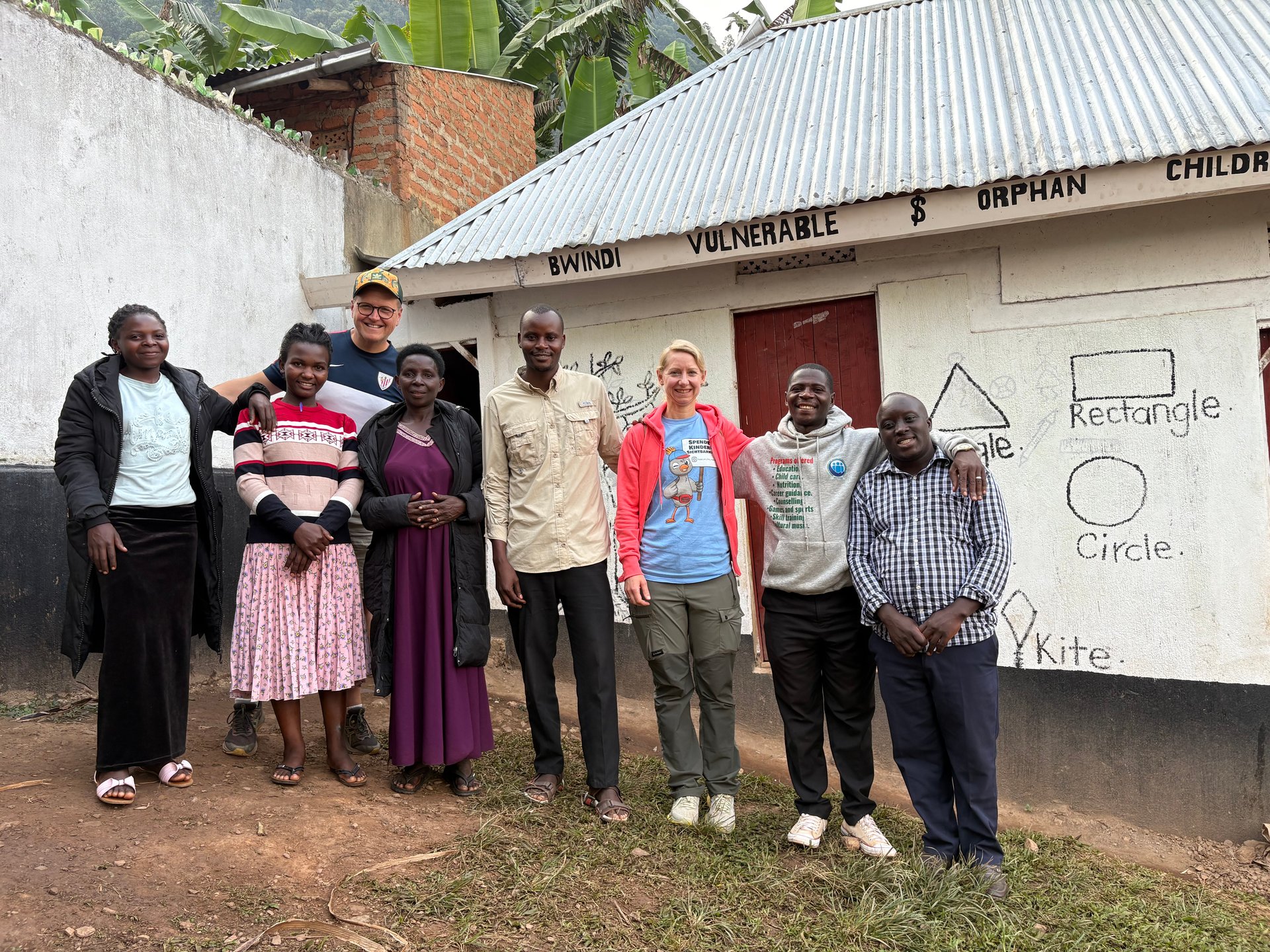
I have visited Uganda fourteen times across extended stays — twelve days in October 2024, eleven days in January 2026, thirteen days in May 2026, and shorter visits in April and June 2026, among others — and I have stayed in accommodation ranging from basic local guesthouses to lodges that cost more per night than most Ugandans earn in a month. These experiences inform how I read the statistical data, because the numbers describe a sector that I have moved through in person, in multiple contexts and price brackets. On 21 June 2026, photographed at GPS coordinates 0.9617°S, 29.6109°E in Buhoma in the Kigezi highlands, I encountered three children from the neighbourhood of the local orphanage — shy, noticeably not doing well, their clothing and behaviour both telling. We invited them to eat with us immediately. That moment did not happen in a hotel. It happened in a community space adjacent to the accommodation cluster that serves Bwindi's gorilla trekking visitors, and the economic connection between those visitors sleeping in those lodges and those children's circumstances is real, even if it is not simple.
This article examines the accommodation sector in Uganda as the data describes it: its economic weight, its visitor base, the categories of establishment it comprises, and what that means for anyone trying to understand either the tourism economy or how to choose where to sleep.
The Economic Weight of Uganda's Accommodation Sector
The contribution of hotels and restaurants to Uganda's GDP grew from 2,768 billion shillings in 2012 to 3,110 billion shillings in 2013 — a 12.4 percent increase in a single year, according to the Statistical Abstract 2014. As a share of GDP at current prices, the sector moved from 5.2 to 5.3 percent. These are not dramatic percentages, but they describe a sector that is both substantial in absolute terms and growing faster than the overall economy in the period documented.
The employment profile that underpins this contribution is broad. According to the Statistical Abstract 2014, tourism sector employment in Uganda encompasses persons working directly in hotels, restaurants, tourism training institutions, tour agencies, tour operator businesses, and recreation activities. This is an important definitional point: "hotels and restaurants" as a GDP category includes a wider employment base than the accommodation sector alone. The cook at a Kampala restaurant and the safari guide in Murchison Falls National Park are both counted within the economic perimeter of this sector, even though their work and their proximity to the physical accommodation stock are very different.
For context: the Uganda tourism sector as a whole generated approximately 979 million USD in annual revenue according to figures from the Statistical Abstract period — making it the country's largest single source of foreign exchange earnings, ahead of coffee exports. Hotels and restaurants represent the built infrastructure through which a significant portion of that income flows. Without places to sleep, Uganda's gorilla trekking permits, national park entries, and cultural tourism revenues would be economically stranded.
Who Stays in Uganda's Hotels: The Visitor Origin Data
The Uganda Bureau of Statistics collects inbound tourist expenditure data through surveys conducted every two years at four major entry and exit points. Road arrivals are tracked at 15 border crossing stations. Together, these data sources allow UBOS to profile the origin, purpose, and expenditure patterns of the visitor population — information that is directly relevant to understanding which segment of the accommodation market any given category of visitor supports.
The most striking single figure from the Statistical Abstract 2014 is the regional composition of Uganda's visitor base: 64 percent of all visitors came from eastern and southern Africa. This is not the pattern one would expect if Uganda's tourism were primarily driven by intercontinental leisure travel — the category that supports the high-end safari lodges and the USD 700 gorilla trekking permits. The majority of people entering Uganda and staying in its accommodation establishments are regional travellers: businesspeople, visiting family members, cross-border traders, and regional tourists from Kenya, Tanzania, Rwanda, South Sudan, and the broader East African Community.
Within national park visitor data, the picture shifts. Foreign non-residents accounted for 47 percent of national park visits in 2013, with East African Community visitors representing a further 24 percent, according to the Statistical Abstract 2014. The parks — particularly Bwindi for gorilla trekking and Murchison Falls for the full safari experience — draw disproportionately from the intercontinental leisure travel market. This creates a two-tier accommodation geography: urban Uganda (especially Kampala and transit routes) is dominated by regional African travellers; conservation Uganda (the park-adjacent accommodation market) is dominated by international leisure visitors paying substantially higher rates.
The Kampala Accommodation Market
Kampala generates approximately 65 percent of Uganda's national GDP and 80 percent of industrial and commercial activity, as noted in the Kampala Capital City Authority's planning documents. The city is also the entry and exit point for virtually all international air arrivals, with Entebbe International Airport located approximately 40 kilometres to the south. This combination — economic concentration, transit function, airport proximity — makes Kampala the largest and most diverse accommodation market in the country.
The city's accommodation range spans international chain hotels in the central business district (serving the business travel and diplomatic market), mid-range hotels serving both regional and international travellers, and a substantial budget guesthouse sector serving backpackers, volunteers, NGO workers, and regional travellers. Kampala is also the departure point for most safari circuits: travellers typically stay one or two nights before driving or flying on to Murchison Falls, Bwindi, Queen Elizabeth, or Kidepo. This creates a transit accommodation demand that is structurally different from the destination accommodation market in the parks.
During my January 2026 stay of eleven days and my October 2024 stay of twelve days, I moved through multiple types of Kampala accommodation as well as lodge accommodation in western Uganda, and the contrast between what serves business travellers in the capital and what serves gorilla trekkers in Buhoma is as large as the contrast between two different countries. The statistical aggregate "hotels and restaurants: 5.3% of GDP" contains both realities within a single number.
Entebbe: Gateway Accommodation
Entebbe, on the northern shore of Lake Victoria approximately 40 kilometres from Kampala, functions as a distinct accommodation market. It hosts the international airport, the Uganda Wildlife Education Centre (UWEC) — which received 257,098 visitors in 2013, 60 percent of them school groups — the botanical garden, and the Ngamba Island Chimpanzee Sanctuary in Lake Victoria. Travellers who arrive on late flights or depart early often overnight in Entebbe rather than Kampala. The town's lakeside setting and lower density compared to the capital make it a pleasant alternative. Several mid-range and upper-mid hotels cluster near the airport and the lakeshore, with a calmer character than Kampala's busier business hotels.
The Accommodation Spectrum: From Budget to Safari Lodge
Uganda's formal accommodation classification system, administered by the Uganda Tourism Board (UTB), assigns star ratings to registered establishments and publishes lists of approved accommodation providers. However, the classified sector represents only a portion of Uganda's actual accommodation stock. A large number of guesthouses, lodges, and campsites operate without formal classification — particularly in rural areas, near national parks, and in regional towns that are off the main tourist circuit.
The statistical methodology used by UBOS for its tourism data acknowledges this limitation. The Tourism Sector Statistical Abstract, published by the Tourism Ministry in 2014, notes the challenges of comprehensive data collection in a sector where the informal component is substantial. Inbound expenditure surveys at major entry points capture the spending patterns of formal-sector visitors; the spending that flows through informal accommodation channels is harder to measure.
From field experience across fourteen visits, the accommodation landscape breaks into several broad functional categories:
How Uganda Counts Its Visitors: Statistical Methodology
Understanding Uganda's tourism and accommodation data requires understanding how it is collected. The Uganda Bureau of Statistics and the Ministry of Tourism, Wildlife and Antiquities jointly produce the Tourism Sector Statistical Abstract, with the 2014 edition documenting the methodology in detail. The data collection system has several components that each capture different segments of the visitor population.
Inbound tourist expenditure surveys are conducted every two years at four major entry and exit points. These capture the spending patterns — including accommodation expenditure — of visitors arriving by the primary gateways (Entebbe International Airport and key land borders). The every-two-years frequency means the data has gaps between measurement points; inferences about trend directions depend on interpolation.
Road arrival data is collected at 15 border crossing points distributed across Uganda's borders with Kenya, Tanzania, Rwanda, the Democratic Republic of Congo, and South Sudan. This network captures the regional African visitor population — the 64 percent of visitors from eastern and southern Africa — which is numerically the largest segment of Uganda's inbound tourism but not necessarily the highest-spending.
National park visitor statistics are maintained by the Uganda Wildlife Authority (UWA), headquartered at Plot 7 Kira Road, Kamwokya, Kampala. Park entry data provides granular information about visitation by origin category (foreign non-resident, East African Community, Ugandan resident) and by specific park. These counts are among the most reliable in the tourism data set, as park entry requires a ticket and the UWA maintains systematic records.
The gap in the data system is the informal accommodation sector — guesthouses and lodges operating outside the formal classification and reporting system. Uganda's tourism statistics are, in this respect, similar to those of most developing countries: the formal data is reasonably reliable for the formal sector, but the informal sector remains significantly undercounted. Any claim to know the precise total number of accommodation establishments in Uganda must acknowledge this limitation honestly.
What the Uganda Tourism Board Registers
The Uganda Tourism Board (UTB) maintains a register of classified accommodation establishments — hotels, lodges, tented camps, and guesthouses that have applied for and received formal classification. Classification criteria cover physical standards (room size, bathroom facilities, fire safety, security) and service standards. Establishments are awarded star ratings on a one-to-five scale for hotels, with separate classification schemes for lodges and camps.
The UTB register is published and updated periodically, and provides the closest available approximation to a formal count of Uganda's accommodation stock. However, the majority of Uganda's actual sleeping capacity — particularly in rural areas and smaller towns — is held in unclassified establishments that have never applied for formal registration. [RECHERCHE NOETIG: current UTB total count of registered accommodation establishments by category]
Accommodation and Conservation Economics
One of the most consequential functions of Uganda's accommodation sector is its role as the delivery mechanism for conservation finance. The logic is straightforward: gorilla trekking generates USD 700 per permit for international visitors; that permit revenue flows to the Uganda Wildlife Authority; UWA distributes 20 percent of park entrance fees to communities neighbouring the parks through the revenue sharing programme. But none of that revenue flow starts without somewhere for trekkers to sleep.
Bwindi Impenetrable National Park recorded 21,695 visitors in 2013, representing 10 percent of Uganda's national park visitor total, according to the Statistical Abstract 2014. The park's gorilla trekking product is entirely dependent on the accommodation infrastructure in Buhoma, Ruhija, Nkuringo, and Rushaga — lodges and guesthouses that accommodate visitors the night before their trekking permit is activated. Without that accommodation base, the daily visitor quota could not be filled; without the daily quota being filled, UWA's revenue and the community sharing programme would both contract.
This dependency runs in both directions. During my June 2026 visit to Buhoma — GPS-documented at 0.9617°S, 29.6109°E — the children from the orphanage neighbourhood who appeared at the edge of a meal were living within walking distance of accommodation establishments that charge some of the highest per-night rates in East Africa. The economic distance between those price points and the circumstances of those children is a measure of how imperfectly the tourism revenue distribution system, however well designed, translates into household-level outcomes in the communities immediately surrounding the parks. The accommodation sector generates the revenue; the distribution mechanisms determine where it lands.
Gulu: Northern Uganda's Accommodation Hub
Gulu with approximately 150,000 inhabitants is the economic centre of northern Uganda and a significant logistics hub for international aid organisations operating along the supply corridor into South Sudan. This function creates a distinct demand for accommodation — not primarily from leisure tourists, but from aid workers, government officials, and business travellers — that has shaped Gulu's hotel stock toward mid-range, functional properties rather than the safari lodge aesthetic of the western parks.
For leisure travellers, Gulu serves primarily as a transit point on the route to either Murchison Falls National Park to the west or Kidepo Valley National Park to the northeast. The drive from Kampala to Gulu is approximately 330 kilometres; most travellers cover it in a day and overnight in Gulu before the final leg to either park. This transit function is economically significant even though it does not generate the headline rates of destination accommodation.
The Masindi Route: Budongo Forest Reserve
Masindi sits 220 kilometres northwest of Kampala, approximately three hours by paved road. It functions as a staging town for Murchison Falls National Park and for visits to the Budongo Forest Reserve, which contains the largest population of East African chimpanzees in Uganda. The route from Kampala to Masindi passes the Ziwa Rhino Sanctuary 50 kilometres before Masindi — an important stop for visitors wanting to see the only wild white rhinos in Uganda. Regular bus services connect Kampala and Masindi, with the journey taking four to five hours and costing approximately 25,000 UGX.
Masindi's accommodation market is a typical example of Uganda's regional town category: a range of guesthouses and small hotels serving both local business travellers and tourists in transit to the parks. The accommodation standards are functional rather than tourist-oriented. Visitors planning overnight stops between Kampala and Murchison Falls often use Masindi; those with more time stop at Ziwa Rhino Sanctuary, which offers accommodation on-site.
Frequently asked questions
How many hotels are there in Uganda?
A precise national count of hotels and accommodation establishments in Uganda is complicated by the country's large informal sector — guesthouses, lodges, and community-run camps operating outside formal classification systems. The Statistical Abstract 2014 documents the sector's economic contribution (3,110 billion UGX, 5.3 percent of GDP) and its employment profile, but does not provide a single national count. The Uganda Tourism Board registers classified establishments; unclassified accommodation is widespread at all price points.
Where do most tourists to Uganda come from?
According to the Uganda Bureau of Statistics Statistical Abstract 2014, 64 percent of visitors to Uganda came from eastern and southern Africa — primarily Kenya, Tanzania, Rwanda, and East African Community member states. Foreign non-residents (intercontinental visitors) accounted for 47 percent of national park visitors in 2013, with EAC visitors a further 24 percent. Tourists reached Uganda from at least 15 different countries in 2013.
What is the best area to stay in Uganda?
The answer depends on purpose. Kampala offers the widest range of formal hotels for business and transit. For gorilla trekking in Bwindi, accommodation clusters around Buhoma, Ruhija, Nkuringo, and Rushaga, ranging from community guesthouses to high-end lodges. For wildlife in Murchison Falls and Queen Elizabeth, options extend from budget campsites to luxury lodges. Entebbe is a quieter alternative to Kampala for lake-adjacent stays near the airport.
How much does accommodation cost in Uganda?
Budget guesthouses in regional towns typically cost USD 10–30 per night. Mid-range lodges near national parks run from USD 80–200. High-end safari lodges adjacent to Bwindi, Murchison Falls, and Queen Elizabeth charge USD 300 to over USD 1,000 per person per night. Gorilla trekking permits (USD 700 for foreign non-residents) are a separate cost. Community-run guesthouses in areas like Buhoma offer an intermediate option with direct benefit to local households.
Is tourism growing in Uganda?
Uganda's tourism sector showed consistent growth in the Statistical Abstract period. Hotels and restaurants grew GDP contribution 12.4 percent between 2012 and 2013. National park visits increased 17.5 percent in the same period. The Uganda Bureau of Statistics tracks inbound expenditure through biennial surveys at four major entry and exit points, with road arrivals monitored at 15 border stations. More recent Statistical Abstract editions (through 2025) continue to document the sector's trajectory.