Overview
Uganda licensed 2,431 wildlife species for export in 2013 — a 26.3 percent decline from 3,297 the previous year — with birds accounting for 74 percent of all licensed exports, according to the Uganda Statistical Abstract 2014. That same year, bush buck led trophy hunting exports with 41 animals, ahead of buffalo (37) and Uganda kob (36). Understanding what Uganda's wildlife trade looks like in practice — who authorises it, which species are involved, and how trends have shifted — requires moving between the data and the landscape it describes.
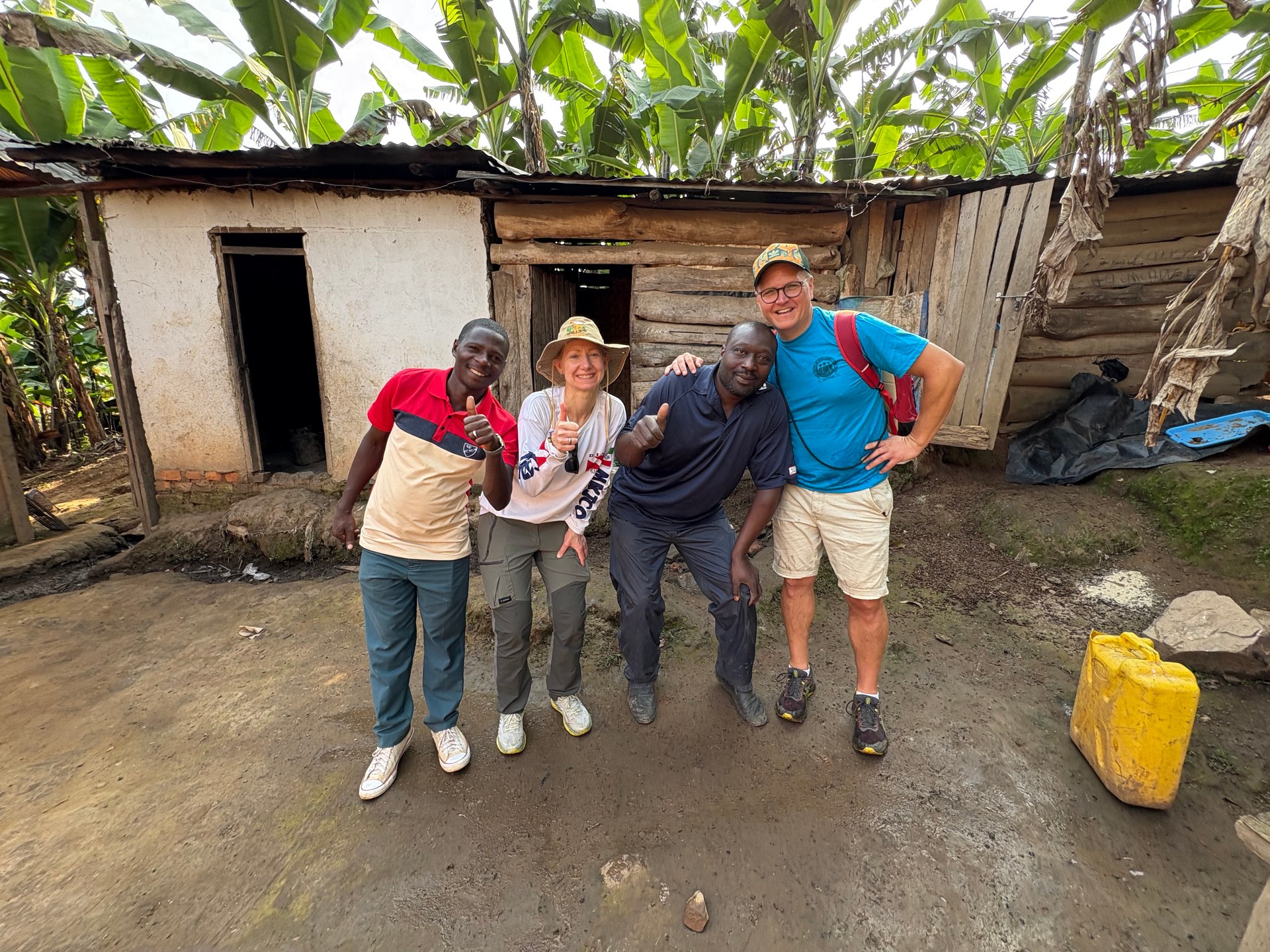
During a visit to Buhoma in June 2026, I spent part of a morning with a local chicken farmer at GPS coordinates 0.9713°S, 29.6142°E. He had been raising chicks with the kind of focused, daily attention that most people reserve for things with obvious commercial scale. His birds were healthy; the facility was clean; the operation was modest by any measure, but clearly the product of someone who had decided that what he was doing mattered and was doing it well. We had visited him several times over the years — buying chicks for the nearby orphanage, which keeps them for eggs or meat. On this visit in June 2026, photographed by Mark Suer, we watched a group of recently hatched chicks being handled and fed with the same care that the larger flock received.
The farmer's operation is not part of Uganda's wildlife trade in any formal sense. His chickens are livestock, not regulated fauna. But the visit is a useful starting point for thinking about Uganda's broader relationship with its animal resources — because the country that manages 2,431 licensed wildlife exports per year also manages smallholder agricultural systems, community food security, and a legal framework that treats living animals as both an economic resource and a conservation responsibility.
Uganda's Bird Diversity: The Foundation of Wildlife Tourism and Trade
Uganda holds more than 1,050 recognised bird species, according to the Statistical Abstract 2014. For comparison, the whole of Europe — a landmass many times Uganda's 241,551 square kilometres — records approximately 700 bird species. The density of avian diversity in Uganda is a function of its geography: the country straddles the equator on a plateau that sits at the convergence of east African savanna, central African rainforest, the Albertine Rift valley, and the Lake Victoria basin. Each ecosystem brings its own bird communities, and the overlaps produce concentrations of endemic and near-endemic species found nowhere else.
The Albertine Rift is one of Africa's most important bird areas. A significant number of Albertine Rift endemics — species restricted to the montane forests running along the western arm of the East African Rift — are found in Uganda's Bwindi Impenetrable, Rwenzori Mountains, and Ruhija sector forests. Birdwatching in these areas, particularly in the Ruhija sector of Bwindi, is regarded by specialist tour operators as among the most productive high-altitude birding available on the continent for the target species list.
Birds also dominate Uganda's regulated wildlife export trade, accounting for 74 percent of all species licensed for export in 2013, according to the Ministry of Tourism, Wildlife and Antiquities. Most bird exports consist of captive-bred or legally obtained specimens for the pet trade, and re-exports — particularly of African Grey Parrots acquired by expatriates during their time in Uganda — are a documented component of this flow. The African Grey Parrot re-export trade operates under licensing because the species is listed under CITES Appendix I, requiring documentation that animals were legally obtained.
The Live Animal Export System: Species, Volumes and Trends
All commercial trade in live wildlife and wildlife products in Uganda is regulated under the Wildlife Act, Cap 200 and the CITES Convention — the Convention on International Trade in Endangered Species of Wild Fauna and Flora. Export licences are issued by the Ministry of Tourism, Wildlife and Antiquities for each transaction, creating a paper trail that allows annual trend analysis.
The 2013 total of 2,431 licensed export species represented a 26.3 percent decline from 3,297 in 2012. The breakdown by taxonomic group tells a more nuanced story. Birds accounted for 74 percent of licensed exports. Chameleons were second at 14 percent — but the chameleon category was in steep decline: from 1,796 animals exported in 2010, the figure fell to just 330 by 2013, an 82 percent reduction over four years, according to the Statistical Abstract 2014. Snakes made up the remaining 12 percent of live wildlife exports, covering multiple species including leopard tortoises (Stigmochelys pardalis) and various snake species, though these are technically reptiles rather than snakes in the strict sense — the abstract groups them together for export accounting purposes.
The chameleon decline is particularly significant. Uganda's montane forests, primarily in the southwest around Bwindi and the Rwenzoris, hold several chameleon species including endemics. The dramatic reduction in export volumes from 2010 to 2013 likely reflects a tightening of licensing rather than a collapse in wild populations — which, if true, represents a conservation success. Global pressure to restrict live reptile trade for the pet market intensified through the early 2010s, and Uganda's declining export numbers track that policy shift.
On the expansion side, the Statistical Abstract 2014 notes that exports of birds and mammals grew during the same period when chameleon and other reptile exports were declining. The Nile crocodile (Crocodylus niloticus) is listed separately in the regulations for commercial ranching — a system that allows captive-bred crocodile skins to be exported from licensed ranching operations, providing economic returns that reduce pressure on wild populations.
Trophy Hunting: Species, Numbers and Regulation
Uganda's Wildlife Use Rights system allows licensed operators to conduct controlled sport hunting in designated areas outside national parks and game reserves. Trophies from these hunts are tracked and licensed for export by the Wildlife Conservation Department under the Ministry of Tourism, Wildlife and Antiquities. The 2013 data, the most detailed available from public UBOS sources, records exports from 22 species of mammals.
Trophy hunting exports, 2013 — top species (source: Statistical Abstract 2014)
The bush buck (Tragelaphus scriptus) is a small to medium forest antelope found throughout Uganda's woodland and forest edge habitats. Its dominance in trophy export numbers reflects its widespread distribution across hunting areas and its accessibility for clients who may not have the tracking endurance required for some of the larger or more elusive species. The leopard, by contrast, appeared in export records for some years (total of 4 individuals across 2010, 2012, and 2013) but was absent from 2015 exports entirely, according to the Statistical Abstract 2016.
Trophy Export Trend Over Time
Looking at the multi-year trajectory provides important context for the 2013 figures. Total trophy export volumes from 2011 to 2016, according to the Statistical Abstract 2017, moved as follows: 288 (2011), 291 (2012), 398 (2013), 373 (2014), 241 (2015), 502 (2016). The 2016 peak of 502 trophies was the highest recorded figure in that dataset. The year-to-year variability reflects both licensing decisions and the operational capacity of the hunting concessionaires — not necessarily fluctuations in wildlife populations.
The 2015 decline to 241 coincided with a broader global conversation about trophy hunting following a high-profile killing of a lion in Zimbabwe that generated substantial international attention. Uganda's numbers moved independently of that event's immediate context, but the policy environment for trophy hunting tightened across the region through 2015 and 2016. That Uganda's 2016 figures then reached their dataset peak suggests the concession system remained operationally active even as public scrutiny increased.
It bears noting that the absolute volumes in Uganda's trophy system are small by southern African standards. Neighbouring Tanzania and Zimbabwe operate hunting operations at scales an order of magnitude larger. Uganda's system is primarily oriented toward its savanna areas in the north and northwest, where the same species mix encountered on a Murchison Falls game drive can, under the right licensing conditions, be hunted in adjacent areas.
Uganda Wildlife Education Centre: From Orphanage to Conservation Hub
The Uganda Wildlife Education Centre (UWEC) in Entebbe occupies a position in Uganda's wildlife landscape that sits quite apart from the national park system. It was opened in 1952 as an animal orphanage, converted into a zoo in the early 1960s, and then transformed into a conservation education centre in May 1994, according to the Statistical Abstract 2014. That transformation — from zoo to education-oriented facility — has shaped how it functions today and who visits it.
In 2013, UWEC received 257,098 visitors — a 1 percent increase from 253,911 in 2012, according to UBOS. That single-year figure exceeded the visitor count at any individual national park in Uganda that year, including Murchison Falls (70,799) and Queen Elizabeth (69,193). UWEC's dominance in raw visitor numbers reflects its location on the Entebbe peninsula — accessible from Kampala in under an hour — and the relatively low cost of entry compared to a national park trip requiring transport and accommodation.
The visitor composition at UWEC differs markedly from national parks. School groups accounted for 60 percent of UWEC visits in 2013, with local adults representing a further 22 percent, according to the Statistical Abstract 2014. International tourists, who dominate national park visitor revenue, are a minority here. UWEC's function is primarily to serve Ugandan children — providing structured encounters with wildlife that most children living in Kampala or nearby towns would not otherwise have access to.
The centre holds animals that were orphaned, rescued, or cannot be safely released. The shoebill stork — endemic to the papyrus swamps of central Africa and one of the most sought-after sightings on any African birding list — is reliably viewable at UWEC in conditions that do not require a boat trip into the Mabamba swamp or a visit to the remote lakes of the north. For visitors combining a Kampala stay with an Entebbe departure, UWEC represents a genuine wildlife encounter without a full safari itinerary.
The Uganda Wildlife Training Institute
Behind the visitor-facing components of Uganda's wildlife system sits an education and training infrastructure that is less visible but no less important. The Uganda Wildlife Training Institute enrolled 121 students in the 2013/14 academic year — a 24.8 percent increase from 97 students in 2012/13, according to the Statistical Abstract 2014. Graduates from the institute move into roles as rangers, wildlife managers, community liaison officers, and conservation educators. They are the people who staff the entry gates whose visitor numbers are cited throughout this article.
In the 2012/13 academic year, 62 students completed their qualifications. The increase to 121 enrolled students the following year suggests either an expansion of intake capacity or a response to growing demand for trained conservation personnel — a demand driven partly by increased park visitation and partly by the growing complexity of managing protected areas under pressure from oil exploration, climate variability, and expanding agricultural margins.
[QUOTE: Uganda Wildlife Training Institute graduate on what the programme prepared them for — collect on next visit to Murchison Falls or UWA offices]
The System as a Whole: Trade, Conservation and Community
Uganda's approach to wildlife — licensing exports, permitting controlled hunting, operating a national zoo and education centre, training conservation professionals — represents a coherent if imperfect system rather than a collection of independent policies. Each component makes more sense in relation to the others. The revenue from licensed wildlife exports and trophy hunting supports the Wildlife Conservation Department that regulates those same activities. UWEC's school group visits build the constituency of Ugandan citizens who value wildlife conservation. The Uganda Wildlife Training Institute produces the workforce that makes the whole system function at the field level.
What the statistics do not show is how those systems interact with the communities that live adjacent to them. The orphanage at Buhoma — where children from the neighbourhood joined a meal because they were hungry — sits within the tourism and conservation economy without necessarily being sustained by it. The chicken farmer photographed at GPS: 0.9713°S, 29.6142°E operates with the same quiet competence and the same constrained margins as agricultural smallholders across the country, unconnected to the licensed export system in which Uganda's bird diversity generates 74 percent of trade volumes.
Both things are part of the same landscape. Accurate knowledge of Uganda requires holding both in view.
Frequently asked questions
How many bird species does Uganda have?
Uganda has more than 1,050 recognised bird species — more than the total for all of Europe (approximately 700), according to the Statistical Abstract 2014. The high diversity reflects Uganda's position at the convergence of east African savanna, central African rainforest, and Albertine Rift montane forest ecosystems. The Albertine Rift corridor is particularly noted for endemic species found nowhere else. For birdwatching access, see the Kibale birdwatching guide .
What wildlife is legally exported from Uganda?
In 2013, Uganda licensed 2,431 wildlife species for export — a 26.3 percent decline from 2012 — regulated under the Wildlife Act Cap 200 and the CITES Convention. Birds accounted for 74 percent of exports, chameleons 14 percent, and snakes 12 percent. The Nile crocodile is separately licensed for commercial ranching and skin export. Re-exports of African Grey Parrots legally acquired by expatriates are also processed under this system. All commercial wildlife trade requires export licences from the Ministry of Tourism, Wildlife and Antiquities.
What is the most commonly hunted trophy animal in Uganda?
Bush buck led Uganda's trophy hunting exports in 2013 with 41 animals, followed by buffalo (37), Uganda kob (36), water buck (34), and sitatunga (32), according to the Statistical Abstract 2014. Trophy hunting operates under Uganda's Wildlife Use Rights system in designated areas outside national parks. Total trophy exports across all species peaked at 502 in 2016 — the highest figure recorded across the 2011–2016 dataset — according to the Statistical Abstract 2017.
When was the Uganda Wildlife Education Centre founded?
UWEC in Entebbe was founded in 1952 as an animal orphanage, converted to a zoo in the early 1960s, and transformed into a conservation education centre in May 1994. In 2013 it received 257,098 visitors — more than any individual national park that year — with school groups accounting for 60 percent. Its proximity to Kampala and Entebbe airport makes it Uganda's most accessible wildlife venue.
Is trophy hunting legal in Uganda?
Yes. Uganda permits controlled trophy hunting through its Wildlife Use Rights system, which licences specific operators in designated areas outside national parks. Trophies are tracked and licensed for export by the Wildlife Conservation Department. In 2013, 22 species were represented in trophy export records, including bush buck, buffalo, Uganda kob, and multiple antelope species. Leopard appeared in some years' exports but was absent in 2015. The Uganda Wildlife Regulations 2022 govern current licensing conditions.