Overview
The two places to go gorilla trekking in Uganda are Bwindi Impenetrable National Park in the southwestern highlands and Mgahinga Gorilla National Park on the slopes of the Virunga volcanoes. Together these parks protect a mountain gorilla population of 459 individuals, according to census data from the 2018–2020 survey period cited in the Uganda Wildlife Authority's State of Wildlife Resources Report 2026. Bwindi accounts for the majority of that population and divides its trekking experience across four distinct sectors, each with its own character and logistics.
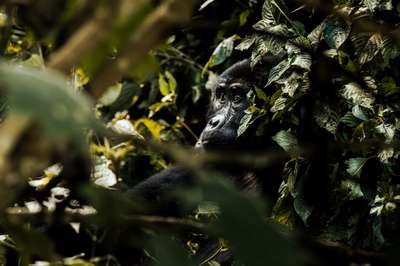
After three hours of pushing through dense undergrowth on our trek in Bwindi, the forest suddenly fell quiet and the guide signalled us to stop. A gorilla family materialized through the foliage — calm, unhurried, and closer than felt possible. It is the kind of encounter that makes every muddy kilometer worthwhile, and it is why gorilla trekking in Bwindi has become one of the defining wildlife experiences on the African continent.
This guide covers where exactly to find mountain gorillas in Uganda, what the current population numbers mean for the species, and what you need to know before you set foot on a trail.
Uganda's Mountain Gorilla Population: Current Numbers
The mountain gorilla (Gorilla beringei beringei) is among the most carefully monitored large mammals on earth. The Uganda Wildlife Authority (UWA) State of Wildlife Resources Report 2026 records a population of 459 individuals in Uganda based on the 2018–2020 census. This figure is remarkable for a species that was considered on the brink of extinction only two decades ago.
The global mountain gorilla population is shared between Uganda, Rwanda, and the Democratic Republic of Congo across the Bwindi and Virunga ecosystems. Uganda's 459 individuals represent the Bwindi population specifically — a genetically distinct grouping that has no contact with the Virunga gorillas. Bwindi is therefore not just a tourism destination; it is an irreplaceable genetic reservoir.
The recovery has been driven by decades of conservation investment, anti-poaching work, and community engagement. The State of Wildlife Resources Report 2026 documents wildlife recoveries across many species in Uganda over recent years, and mountain gorillas are among the most visible success stories. That said, the species remains endangered, and the UWA continues to monitor threats carefully.
Why the Census Numbers Matter for Trekking
Population size directly shapes how many gorilla groups can be habituated for tourism. Habituation — the multi-year process of acclimatizing a wild gorilla family to regular human presence — is resource-intensive and carries ecological risks if pushed too far. The UWA's management plan for Bwindi explicitly notes that research is underway to identify the optimal number of groups that can be habituated without negatively affecting the resource base or the animals' welfare.
Each trekking permit grants access to one habituated group for one hour. This strict limit is why permit availability, not the forest's carrying capacity, is the practical constraint on how many visitors can trek in a given season.
Bwindi Impenetrable National Park: The Primary Trekking Destination
Bwindi Impenetrable National Park sits in Uganda's far southwest, straddling the border of the Albertine Rift. The park covers 331 square kilometres of montane and lowland forest — one of Africa's oldest and most biodiverse forests, classified as a World Heritage Site partly because it functions as a Pleistocene refugium, meaning it survived past ice ages and harbours species found nowhere else on earth.
Uganda straddles seven of Africa's unique biogeographic regions, according to the State of Wildlife Resources Report 2026, and Bwindi is where several of those regions converge. Three butterfly species are found only in Bwindi. The forest protects a large share of Albertine Rift endemic species and plays a critical role in water catchment and carbon sequestration for the broader region.
For gorilla trekking, the park is accessed through four sectors. Each sector has its own rangers, trails, and habituated gorilla groups. The sectors are not connected by road, so choosing a sector means choosing a base for your stay.
Buhoma: The Original Sector
Buhoma is the oldest and most established of the four sectors, located on the park's northern edge. It was the entry point when gorilla trekking first opened to visitors and retains a well-developed infrastructure of lodges, community tourism initiatives, and ranger facilities. Our visits over multiple trips — most recently during extended stays in January 2026 and May 2026 — repeatedly brought us back to this area. The community around Buhoma has built a significant relationship with conservation income, with local guides, porters, and guesthouses all drawing income from trekking activity.
The community tourism network around Buhoma extends beyond the park itself, offering cultural walks, craft visits, and interactions with the Batwa, the indigenous forest people of the region. This broader ecosystem makes Buhoma a natural choice for visitors who want to understand the human dimension of gorilla conservation alongside the wildlife experience.
Ruhija, Rushaga, and Nkuringo
Ruhija sits in the park's eastern highlands at higher elevation, making it cooler and often mistier. The trails here are challenging but the forests reward the effort with excellent bird diversity on top of gorilla encounters. Rushaga in the south holds the largest number of habituated gorilla groups in any single sector, making it a strong option for travellers for whom permit availability is the main concern. Nkuringo, also in the south, perches on a ridge with dramatic views across the forest and into the Congo basin.
For a detailed breakdown of what distinguishes each sector in terms of difficulty, scenery, and permit strategy, see our dedicated guide to Bwindi gorilla trekking sectors.
Conservation Values and Management Challenges
Bwindi's World Heritage status rests on a remarkable suite of values. Beyond the gorillas, the park provides habitat for endangered species across the full forest, serves as a major water catchment area, acts as a carbon sink, and holds deep cultural significance for indigenous communities who derive part of their livelihood from forest resources. The park is also a living laboratory for evolutionary science, given the extraordinarily high degree of endemism left intact since the Pleistocene.
The UWA management plan identifies a set of recurring pressures that rangers and planners must navigate. Incompatible land use along the park boundary — particularly the growing of food crops right up against the forest edge — creates regular conflict as gorillas and other wildlife raid fields. The human population surrounding Bwindi has grown steadily, intensifying pressure on the park boundary. There is also ongoing interest from mining operations targeting wolfram, gold, and iron ore deposits in the area, which the UWA must manage against its conservation mandate.
Within the park, the changing home ranges of habituated gorilla groups present a monitoring challenge. Groups do not stay in fixed territories, and their movements sometimes bring them outside park boundaries, complicating both safety protocols and the logistics of tracking for rangers. Wildlife diseases — particularly zoonotic diseases such as scabies, which affects mountain gorillas — remain a standing concern. The National Status of the Environment Report 2024 highlights that diseases like scabies can move between humans and gorillas, which is why strict hygiene rules apply during all trekking encounters: no trek if you are ill, masks worn within seven metres of the animals, and a minimum approach distance enforced by guides.
Mgahinga Gorilla National Park: The Second Location
Mgahinga Gorilla National Park takes its name from Mount Gahinga, a dormant volcano rising to 3,475 metres and covered in bamboo forest. The park protects the Ugandan section of the Virunga Massif, a chain of volcanoes shared with Rwanda and the DRC. It is smaller than Bwindi and receives fewer visitors, but it offers a distinct experience: gorilla trekking in a high-altitude volcanic landscape, with the added possibility of golden monkey tracking in the bamboo zones.
The gorilla family at Mgahinga sometimes crosses into Rwanda, which is one reason visits here involve a degree of uncertainty — rangers track the family daily and trekking is only confirmed once the group is located within Ugandan territory. This unpredictability is less common at Bwindi, where multiple habituated groups ensure that a trek almost always proceeds.
The Stone Wall and Community Buffer
One of the more unusual features of Mgahinga's management is the 16-kilometre stone wall maintained by the UWA along the park boundary. The wall serves as a physical barrier to reduce crop raiding by gorillas — an ongoing source of tension between the park and the farming communities that surround it. UWA records confirm this structure has been in continuous operation as a human-wildlife conflict mitigation measure.
Crop raiding is not a trivial issue. When gorillas or other large animals repeatedly destroy harvests, it erodes community tolerance for conservation and generates hostility toward the park and the animals it protects. The stone wall, combined with problem animal response teams and community education programmes, forms part of the UWA's strategy for maintaining goodwill in the areas surrounding Mgahinga.
The broader question of human-wildlife conflict across Uganda — how it is measured, managed, and funded — is a subject the UWA's State of Wildlife Resources Report 2026 addresses in considerable detail across multiple parks.
Getting to Gorilla Country: Practical Access
Both Bwindi and Mgahinga are in Uganda's far southwest, roughly 500 kilometres from Kampala by road. The standard overland route runs south-west from Kampala through Mbarara and Kabale before continuing to the park gates. The drive from Kampala to Buhoma takes approximately eight to ten hours depending on road conditions and traffic. Kabale, the nearest substantial town, serves as a useful stopover and supply point for both parks.
For those with limited time, charter flights to the Kihihi or Kisoro airstrips put you within an hour's drive of the relevant park gates. These strips are served by light aircraft companies operating out of Entebbe. The cost is considerably higher than overland travel, but for itineraries combining multiple parks the time savings are significant.
A full overview of western Uganda's national parks and how to plan a circuit that includes Bwindi alongside Queen Elizabeth and other parks is worth reading before finalising an itinerary.
Permits: What You Need to Know
A gorilla trekking permit from the UWA is mandatory for every visitor and must be obtained in advance. The permit grants access to one habituated gorilla family for a single one-hour encounter. Only eight people per group per gorilla family per day are allowed, which keeps each encounter intimate and limits cumulative disturbance to the animals.
Permit prices have increased over the years as the UWA has moved to align conservation income with the cost of protection. The Uganda Wildlife Authority plans to implement additional tourism levies to generate conservation funding, according to the State of Wildlife Resources Report 2026. Revenue sharing with surrounding communities is a core part of the framework — a percentage of permit fees flows to local councils and community projects — though the management plan for Bwindi acknowledges that this mechanism has not always delivered benefits to the people most directly affected by the park's existence.
Permits sell out far in advance during peak season (June–August and December–January). Booking six months ahead is a reasonable rule for those travelling during these windows.
The Encounter: What Happens During a Trek
The day starts early at the ranger station. Guides brief the group on rules: maintain a minimum distance of seven metres, do not eat or drink in front of the gorillas, do not use flash photography, and follow the lead guide's instructions without hesitation. Porters are available for hire, and on steep terrain in Bwindi they are genuinely useful rather than simply a convenience.
Rangers track the gorilla family's location from the previous day's nest site. Progress through the forest depends entirely on where the animals have moved. On our own trek in Bwindi, three hours of walking brought us to a family that was calm and largely indifferent to our presence — moving through the undergrowth, eating, and occasionally turning to look at us with the particular directness that makes every photographer instinctively raise their camera.
Once found, you have one hour. The hour passes quickly. Guides manage the group's position relative to the gorillas to keep the encounter safe for both parties. If a silverback moves toward the group, guides instruct everyone to crouch, look down, and remain still. This is not a precaution taken lightly — silverbacks are large, powerful animals, and the protocols exist for good reason. Our experience on multiple visits has been that the gorillas, once habituated, are genuinely calm. The intensity of the encounter comes not from danger but from proximity: a large primate sitting a few metres away, sharing an evolutionary history with you, is an experience that resists easy description.
For a deeper account of what the trekking experience involves day by day — from pre-dawn preparation to the post-trek debrief — the Bwindi gorilla trekking experience guide covers the practical and personal dimensions in detail.
Uganda's Biodiversity Context: Why Gorillas Thrive Here
Uganda's exceptional natural heritage is not an accident of geography. The country straddles seven of Africa's unique biogeographic regions, according to the State of Wildlife Resources Report 2026, creating overlapping habitats that support extraordinary species density. Iconic mammals — elephants, mountain gorillas, lions, and Rothschild's giraffes — share the country with over 1,000 bird species and a plant diversity that places Uganda among the most biologically rich nations on the continent.
Bwindi's specific position at the meeting point of montane and lowland forest zones amplifies this diversity. The park's high endemism — including those three butterfly species found nowhere else on earth — is a function of its survival through the Pleistocene as a forest island in a landscape that was otherwise drier and more open. The forest's stability over geological time has allowed species to differentiate in isolation, producing the concentration of endemic and rare life that justified its World Heritage designation.
The National Status of the Environment Report 2024 notes that Uganda's government has committed to increasing national forest cover from 12 percent (as of 2021) to 21 percent by 2030. This target matters for gorilla conservation beyond Bwindi itself: the forest connectivity between protected areas, the quality of the surrounding landscape, and the availability of water resources in the wider ecosystem all shape how well the gorilla population can sustain its recovery.
Conservation Threats and the Work Behind the Experience
The hour spent watching a gorilla family in Bwindi is the visible tip of a large conservation operation. The UWA maintains ranger patrols, veterinary monitoring, community liaison programmes, boundary management, and research activities across the park year-round. Each of these functions is essential to the gorilla population's continued recovery.
Disease Surveillance
Gorillas share approximately 98 percent of their DNA with humans, which means they are susceptible to many of the same respiratory and skin diseases. Scabies has been documented affecting mountain gorillas. The UWA's management plan for Bwindi includes disease surveillance and outbreak management as a dedicated action area, and the park has arrangements with the Conservation Through Public Health (CTPH) organisation for joint management of veterinary infrastructure. Rangers and trackers who work closely with gorilla families receive health checks and must not work when ill.
Wire Snares and Anti-Poaching
Wire snares set for bush pigs and antelopes can injure or kill gorillas that encounter them incidentally. Anti-poaching patrols in Bwindi remove snares and investigate poaching activity. The UWA works with the Uganda Police, the Uganda Revenue Authority, and specialist dog units in enforcement operations. For a broader picture of how wire snare poaching affects Uganda's wildlife, including the scale of the problem and recovery efforts, our dedicated article covers the latest data.
Research and Monitoring
The UWA's planned research actions for Bwindi include conducting studies on changing gorilla home ranges, investigating the optimal number of groups that can be habituated for tourism, reviewing gorilla ranging behaviour outside park boundaries, carrying out biodiversity inventories, and conducting periodic population censuses of key species including gorillas, chimpanzees, and elephants. This research base underpins every management decision the park makes about habituation, permit numbers, and ranger deployment.
Personal Observations from Multiple Visits
Between October 2024 and May 2026, I made several extended trips to southwestern Uganda, spending time in and around Bwindi and the broader Kabale region. These visits accumulated to well over 50 days on the ground across 14 trips in total. The pattern of the forest does not become mundane with familiarity: each trek follows different terrain, encounters different weather, and finds the gorilla groups in different configurations. What does become familiar, and valuable, is the human context — the rangers who know individual gorillas by name and can identify them from posture alone, the community members around Buhoma whose livelihoods are now inseparable from the park's health, and the guides whose knowledge of the forest's ecology goes well beyond what any briefing document can convey.
[QUOTE: local guide on first impressions of the gorilla families — to be added on next visit]
What the statistics cannot fully capture is how the gorilla population recovery has changed the atmosphere in communities near the park. When conservation generates direct income — through permits, guiding fees, porter wages, and lodge employment — attitudes toward wildlife shift in ways that reinforce protection rather than working against it. This is the model that Bwindi has refined over three decades, and it is the reason the 459 individuals in Uganda's census represent an ongoing recovery rather than a final count.
For visitors thinking about how gorilla tourism connects to Uganda's broader economy, our analysis of Uganda's tourism economy — including how wildlife revenues flow through the system — provides useful context.
Aktuelle Bestandszahlen
Uganda beherbergt etwa 459 Berggorillas, das entspricht 52 Prozent der weltweiten Population von rund 1.063 Tieren.
Die Berggorilla-Population in Uganda umfasst nach aktuellem Kenntnisstand rund 459 Tiere. Sie leben in den beiden Schutzgebieten Bwindi Impenetrable National Park und Mgahinga Gorilla National Park im Südwesten des Landes. Diese Zahl entspricht etwa 52 Prozent der gesamten weltweiten Berggorilla-Population.
Die globale Population wird auf rund 1.063 Individuen geschätzt. Damit liegt die Weltpopulation nach übereinstimmenden Angaben der Greater Virunga Transboundary Collaboration (GVTC) erstmals wieder über der Marke von 1.000 Tieren. Die zugrunde liegenden Daten stammen unter anderem aus dem MTWA Statistical Abstract 2025, der im April 2026 veröffentlicht wurde und die aktuellste verfügbare Datenbasis zu Uganda liefert.
Diese Zahlen werden durch mehrere unabhängige Quellen konsistent bestätigt und gelten als gesicherter Stand.
Verbreitungsgebiete des Berggorillas: Bwindi, Mgahinga und das Virunga-Massiv
Berggorillas leben nicht nur in Uganda, sondern auch im grenzüberschreitenden Virunga-Massiv zwischen Ruanda und der Demokratischen Republik Kongo.
Der Berggorilla kommt weltweit nur in zwei getrennten Gebieten vor. Das eine ist der Bwindi Impenetrable National Park zusammen mit dem angrenzenden Mgahinga Gorilla National Park in Uganda. Das andere ist das Virunga-Massiv, eine Vulkanregion, die sich über die Grenzen von Uganda, Ruanda und der Demokratischen Republik Kongo erstreckt und unter anderem den Parc National des Virunga umfasst.
Der Schutz der Berggorillas in diesen Gebieten wird länderübergreifend koordiniert, unter anderem durch die Greater Virunga Transboundary Collaboration, ein Zusammenschluss der Naturschutzbehörden von Uganda, Ruanda und der DR Kongo.
Berggorilla und Grauergorilla: Zwei verschiedene Unterarten
Der Berggorilla wird häufig mit dem Grauergorilla verwechselt, der auch als Östlicher Flachlandgorilla bekannt ist. Beide gehören zur Art des Östlichen Gorillas, sind aber unterschiedliche Unterarten mit getrennten Lebensräumen. Der Grauergorilla lebt in den Tieflandwäldern der Demokratischen Republik Kongo, unter anderem im Parc National de Kahuzi-Biéga, während der Berggorilla ausschließlich in den Hochlandregionen von Bwindi/Mgahinga und dem Virunga-Massiv vorkommt. Die beiden Unterarten unterscheiden sich unter anderem in Fellstruktur und Körperbau, angepasst an die jeweiligen Höhenlagen ihres Lebensraums.
Warum steigen die Bestandszahlen wieder?
Konsequenter Schutz durch Nationalparkbehörden und internationale Zusammenarbeit gilt als zentraler Faktor für die Erholung der Population.
Nach jahrzehntelangem Rückgang zeigt die Berggorilla-Population seit einigen Jahren einen Erholungstrend. Uganda Wildlife Authority überwacht die Populationen in Bwindi und Mgahinga fortlaufend, während grenzüberschreitende Initiativen wie die GVTC die Zusammenarbeit zwischen den Schutzgebieten in Uganda, Ruanda und der DR Kongo koordinieren.
Auch internationale Naturschutzorganisationen tragen zum Schutz der verbleibenden Lebensräume bei. Konkrete Details zur Rolle einzelner Organisationen im ugandischen Kontext lassen sich derzeit nicht abschließend belegen und werden hier bewusst nicht ausgeführt.
From the field
Frequently asked questions
How many mountain gorillas are there in Uganda?
According to the 2018–2020 census data cited in the Uganda Wildlife Authority State of Wildlife Resources Report 2026, Uganda hosts 459 individual mountain gorillas. The majority live within Bwindi Impenetrable National Park, with a smaller population in Mgahinga Gorilla National Park. The species remains endangered globally, but its numbers in Uganda have shown a sustained recovery over recent decades.
Where can you go gorilla trekking in Uganda?
Gorilla trekking in Uganda takes place in two national parks: Bwindi Impenetrable National Park in the southwest, which is divided into four trekking sectors (Buhoma, Ruhija, Rushaga, and Nkuringo), and Mgahinga Gorilla National Park on the slopes of the Virunga volcanoes. Bwindi has more habituated gorilla groups and is the more visited destination; Mgahinga offers a high-altitude volcanic landscape experience but carries a small chance the gorilla family has crossed into Rwanda on any given day.
How long does gorilla trekking in Bwindi take?
The duration varies considerably depending on where the gorilla family has moved on a given day. Treks typically last between one and five hours of walking each way through dense, often steep forest. Our own trek in Bwindi took roughly three hours before we reached a habituated gorilla family. Once with the gorillas, you have exactly one hour — this is enforced regardless of how quickly or slowly the trek itself proceeded. Hiring a porter for steep terrain is strongly advisable.
What are the main threats to mountain gorillas in Bwindi?
The Uganda Wildlife Authority identifies several key threats in Bwindi's management plan: incompatible land use and crop farming along the park boundary, growing human population pressure, mining interests (wolfram, gold, and iron ore), changing home ranges of habituated gorilla groups, and zoonotic diseases such as scabies. The park authority conducts disease surveillance, maintains veterinary infrastructure with the Conservation Through Public Health organisation, and researches the optimal number of groups that can be habituated without harming the wider ecosystem.
Does Mgahinga Gorilla National Park have gorillas?
Yes. Mgahinga Gorilla National Park, named after Mount Gahinga (3,475 m), protects a portion of the Virunga Massif and is home to mountain gorillas. The Uganda Wildlife Authority maintains a 16-kilometre stone wall along the park boundary to reduce crop raiding by gorillas, helping ease tensions between the park and surrounding farming communities. Because Mgahinga gorillas sometimes cross into Rwanda, trekking is only confirmed on the morning of your booking once rangers have located the family on Ugandan soil.